
By Bernard F. Miller KC, ICD.D
On September 13, 1970, Milton Friedman, then professor of economics at the University of Chicago and later a Nobel laureate, published an essay in The New York Times Magazine under the headline “The Social Responsibility of Business Is to Increase Its Profits.” It became one of the most consequential opinion pieces in the history of capitalism. It supplied the intellectual foundation for half a century of shareholder primacy. And it rested on a legal claim that was simply wrong.
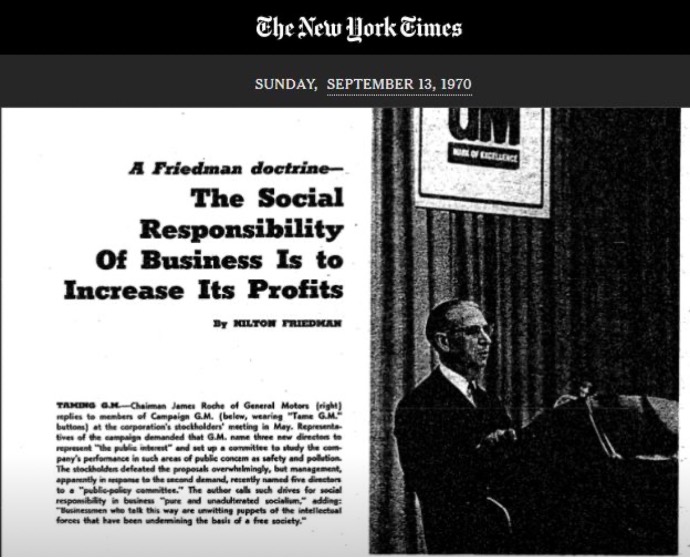
The photograph shows General Motors chairman James Roche at the company’s stockholders’ meeting that spring: the same corporation Peter Drucker had studied a quarter century earlier.
Friedman’s argument depended on a single premise. The corporate executive, he wrote, is “an employee of the owners of the business.” The shareholders own the corporation. The managers are their agents. An agent who spends the principal’s money on social purposes is spending other people’s money without consent. Everything else in the essay follows from that premise.
The premise is false. It was false in 1970, and it had been false for more than seventy years before that.
The Law Milton Friedman Ignored
The foundational case of Anglo-American corporate law is Salomon v Salomon & Co Ltd, decided by the House of Lords in 1897. Lord Macnaghten put the principle plainly: “The company is at law a different person altogether” from the people who subscribe for its shares. Incorporation creates a new legal person. That person owns the business, holds the assets, employs the managers, and bears the obligations. The shareholders own none of these things. They own shares: a bundle of limited rights to vote, to receive dividends if declared, and to share in any surplus on winding up.
The House of Lords drew out the consequence in Macaura v Northern Assurance Co in 1925. Mr. Macaura owned every share in a timber company. When the timber burned, his insurance claim failed. He had no insurable interest in the company’s property, because the company’s property was not his. A person who owns all the shares of a corporation still does not own what the corporation owns.
Canadian law is equally clear about whom the managers serve. In Peoples Department Stores Inc. v Wise in 2004, and again in BCE Inc. v 1976 Debentureholders in 2008, the Supreme Court of Canada held that directors and officers owe their fiduciary duty to the corporation itself, not to the shareholders. In discharging that duty, the Court said, they may legitimately consider the interests of shareholders, employees, creditors, consumers, governments, and the environment. Parliament codified that list in 2019, in section 122(1.1) of the Canada Business Corporations Act.
Nor do managers satisfy the legal definition of agents of the shareholders. An agent acts subject to the principal’s control and binds the principal by their acts. Shareholders cannot instruct managers in the conduct of the business. Managers bind the corporation, not the shareholders. Shareholders bear no liability for what managers do. Every element of the agency relationship Friedman asserted is absent. The late Lynn Stout, Distinguished Professor of Corporate and Business Law at Cornell Law School, spent much of her career documenting this point. Her conclusion was blunt: shareholder primacy is not a legal requirement. It is a choice, dressed up as an obligation.
The Rigour Friedman Lacked
Friedman was one of the great economists of the twentieth century. But the central claim of his most famous essay was not an economic claim. It was a legal one: a claim about ownership, agency, and duty. He offered no legal analysis to support it. He cited no case, no statute, no authority. He asserted the premise and built the edifice on top of it.
He came close to noticing the problem. The corporation, he conceded in the essay, is “an artificial person.” Precisely so. But he treated the observation as a curiosity and moved on. Had he taken his own concession seriously, the argument would have collapsed. An artificial person cannot be reduced to its shareholders, because the entire point of creating it was to establish something legally distinct from them. Friedman needed the corporation to be a mere veil over shareholder property. Seventy years of settled law said it was not. He never engaged the contradiction. That is not rigour. That is advocacy.
What Drucker Saw
The law was not the only thing Friedman ignored. He also had a quarter century of evidence available to him, gathered from inside the largest corporation on earth.
In 1943, General Motors invited Peter Drucker, the Austrian-born writer and consultant who would become the most influential management thinker of the twentieth century, to study the company from the inside. He spent eighteen months in its plants, offices, and boardrooms. The result, published in 1946 as Concept of the Corporation, was the first serious empirical study of the modern corporation as it actually functioned.
Drucker’s conclusion anticipated the law rather than contradicted it. The large corporation, he found, was “the representative institution of our society.” It was a human organization before it was an economic mechanism. It was, in a word, a community. Its workers needed status and function within it, not merely wages from it. Its prosperity depended on the health of the society around it, and society’s prosperity depended on the corporation in turn. Half the book is devoted to the corporation’s responsibilities to its people and to the community, which Drucker treated not as charity but as the conditions of the enterprise’s own survival.
General Motors had asked for a study of its management structure. It received a portrait of a social institution, and it was dismayed. American business largely set the book’s central insight aside. Postwar Japanese industry did not, and Drucker spent decades pointing out what it built on that foundation.
So the position in 1970 was this. The settled law said the corporation was a separate person to whom the managers owed their duty. The deepest empirical study of the corporation ever conducted said it was a community. Friedman’s essay engaged neither. It asserted a premise that both the law and the evidence had already rejected, and half a century of corporate practice was reorganized around it.
What a Corporation Actually Is
The older name tells the truth that the Friedman Doctrine obscured. The law calls a corporation a body corporate: from the Latin corpus, a body. Incorporation takes a collection of people, those who invest, those who direct, those who manage, those who work, and constitutes them as a single body in law. The legal fiction is not a disguise for shareholder property. It is the recognition of a community. That is what the House of Lords declared in 1897, and what Drucker observed on the shop floors of General Motors in 1946.
Managers, on this view, are not agents of the shareholders. They are part of the community which the body corporate comprises. They are its hands and its judgment, what the law has long called its directing mind. Their duty runs to the whole body, which is why the Supreme Court of Canada could say without strain that serving the corporation may mean weighing the interests of employees and communities alongside those of investors. The law never adopted the Friedman Doctrine. Corporate practice did, and then mistook its own habit for a legal command.
This matters beyond the correction of a fifty-year-old error. If the corporation is, in law, a community constituted for a common purpose, then corporate architecture is not fixed. It can be designed. Nova Scotia’s Community Interest Companies Act of 2016 does exactly that: it takes the same legal fiction and constitutes a body corporate whose purpose is the benefit of the community itself. That is not a departure from the nature of the corporation. It is a return to it.
Milton Friedman told us the corporation could have only one purpose because it could have only one master. The law tells us otherwise. The corporation has no master. It has members. And what a community of members chooses to build is, and always has been, up to us.
About the Author
Bernard Miller KC, ICD.D is a lawyer and senior public servant. He is currently Executive Chair of Restorative Change Lab CIC.
The views expressed in this essay are the author’s own independent views and do not represent the position of any organization with which he is or has been affiliated.

