
A concept from a Harvard Business Review article transformed a stagnant professional services firm. The same logic — put the people who do the work first, and growth follows — may be exactly what Nova Scotia’s economic policy has been missing.
By Bernard F. Miller KC, ICD.D | Contributing to A Better Place
Sometime around 2009, I was managing partner of a law firm that had been doing everything right and going nowhere. Billings were flat. Good associates were leaving. The partners were grinding harder, and the numbers showed it — but not in the way we wanted.
Then I read an article in the Harvard Business Review by James Heskett, Thomas Jones, Gary Loveman, Earl Sasser, and Leonard Schlesinger. Published originally in 1994, it had been largely ignored by the professional services world. Its title was straightforward: “Putting the Service-Profit Chain to Work.” Its argument was, at the time, almost heretical.
Don’t start with the client. Start with the employee.
The Chain, Explained
The service-profit chain is a causal model. It describes a sequence of linked relationships that the HBR researchers had validated empirically across dozens of service businesses. The logic runs like this:
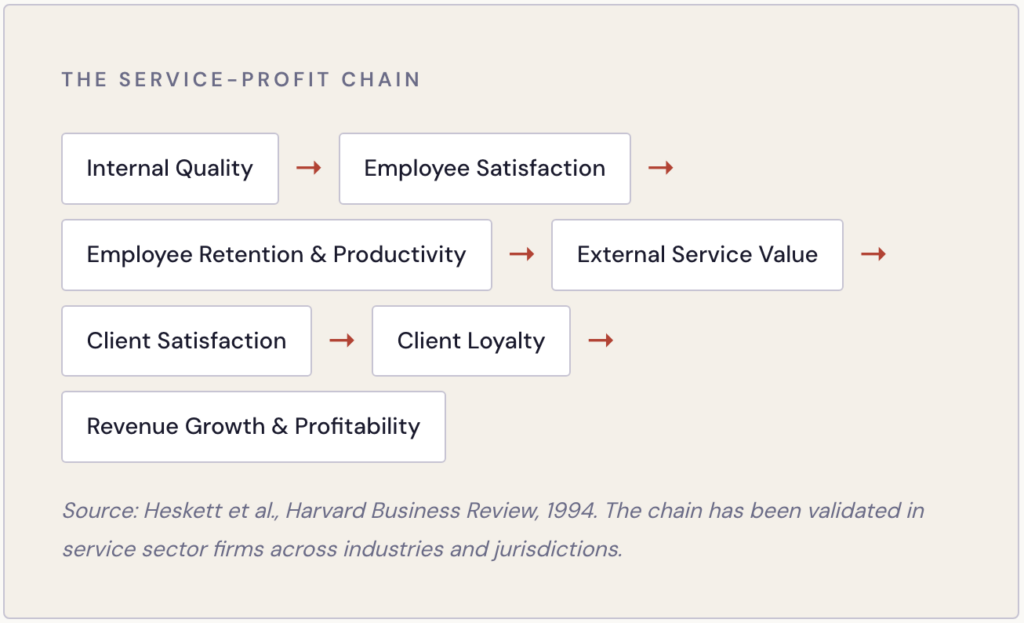
The first link is the most counterintuitive: internal quality. This means the quality of the working environment — the tools people have, the training they receive, the degree of autonomy in their roles, the fairness of their compensation, the culture of the organization. When internal quality is high, employee satisfaction follows. When employees are satisfied, they stay. When they stay, they get better at their work. When they’re good at their work, clients receive something genuinely valuable. Satisfied clients become loyal clients. Loyal clients generate the kind of recurring, referred, compounding growth that no marketing budget can buy.
It sounds obvious in retrospect. At the time, it cut against the grain of almost everything taught in management schools, where the customer is always the starting point.
“We stopped asking what our clients needed. We started asking what our lawyers needed to do their best work. Within three years, the firm’s growth trajectory had reversed entirely.”
We redesigned our internal practices from the inside out. Better tools. More meaningful work. Real mentorship. Transparent compensation. A culture that treated associates as future partners rather than billable-hour machines. We stopped asking what our clients needed and started asking what our people needed to do their best work. Revenue followed. Within three years, the firm’s growth trajectory had reversed entirely.
The Knowledge Worker Dimension
The service-profit chain was originally developed for consumer service businesses — hotels, airlines, retail banks. But its logic applies with even greater force to knowledge work, and that matters for this argument.
In a professional services firm — law, consulting, accounting, engineering, software development — the product is inseparable from the person who produces it. A lawyer’s judgment, a consultant’s insight, a developer’s architecture — these cannot be standardized, inventoried, or quality-controlled in the way a manufactured good can. The quality of the output depends entirely on the quality of the person, and the quality of the person depends substantially on the conditions under which they work.
This makes knowledge workers both more sensitive to the internal quality environment and more capable of generating extraordinary value when that environment is right. A disengaged, burned-out knowledge worker doesn’t just produce less; they produce worse. A fulfilled, well-supported knowledge worker doesn’t just produce more; they produce better — and better, in knowledge work, compounds.
Why This Matters for Policy
In the 20th century, governments grew economies by building infrastructure — roads, ports, power grids — and attracting capital investment. In the knowledge economy, the fundamental inputs are people: their skills, their creativity, their willingness to stay and build. Infrastructure for the knowledge economy is the infrastructure of human well-being.
The province that figures this out first — that treats resident well-being not as a social spending line item but as its primary economic investment — will attract and retain the talent that 21st-century growth runs on.
Nova Scotia’s Chain Problem
Nova Scotia has spent most of the last 150 years trying to grow its economy by working backward through the chain — or ignoring it entirely. The dominant model has been attraction-based: attract capital, attract industry, attract tourists, attract federal transfers. The results, measured honestly, have been modest. The province has never closed the GDP per capita gap with the Canadian average. Its population fell or stagnated for most of the period from 1970 to 2015. Its young people left in waves — not because they didn’t love the place, but because the place didn’t offer them enough.
A Better Place: Finding New Paths to Economic Growth and Social Well-Being in Nova Scotia, a forthcoming policy-oriented book drawing on decades of provincial economic history, documents this pattern in unsettling detail. From the Industrial Estates Limited misadventures of the 1960s — which brought Michelin tires and Clairtone stereos and several expensive failures — to the chronic underinvestment in people that has characterized provincial policy for generations, the record is of a province that kept trying to solve a knowledge-economy problem with industrial-era tools.
The inflection came, quietly, around 2015. A shift in immigration policy, a new tech ecosystem beginning to take shape in Halifax, a recognition that the province’s quality of place — its coastlines, its communities, its relative affordability, the density of trusted relationships that characterize smaller societies — was a genuine competitive asset in a world of mobile knowledge workers. The province’s population began to grow for the first time in a generation.
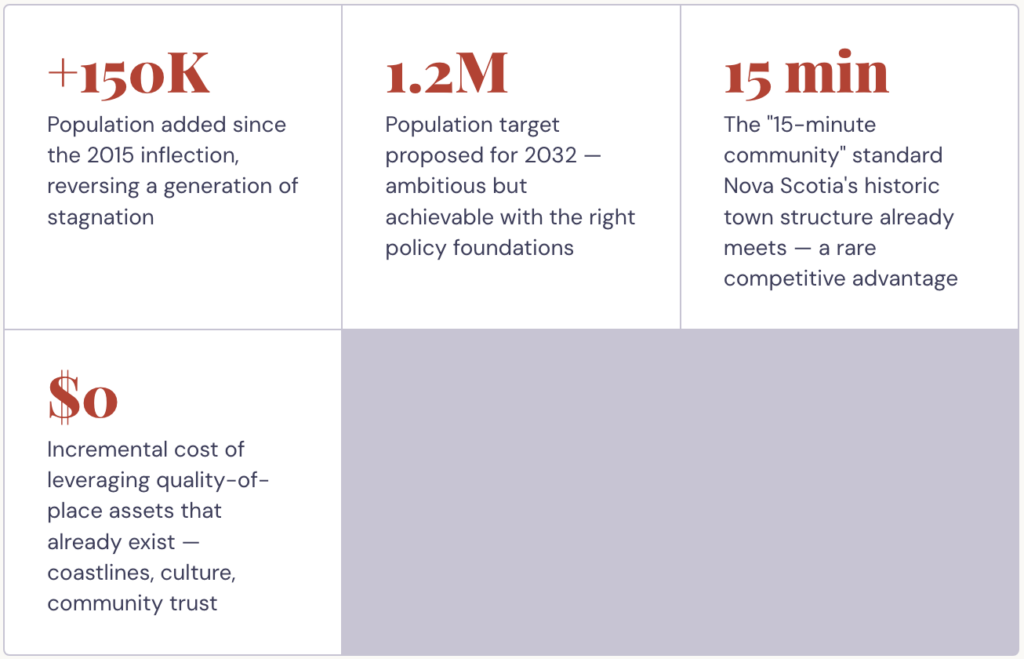
COVID-19 accelerated what 2015 had begun. Remote work became normalized. The calculus for knowledge workers changed fundamentally: if you can work from anywhere, why work from a cramped, expensive city? Nova Scotia, suddenly, was in the game in a way it had never been before.
But here is the problem: the province risks missing this moment by continuing to think about economic development in the old way — as something government does to the economy rather than as something that emerges from the conditions government creates for the people who live here.
A Provincial Service-Profit Chain
What would it mean to apply the service-profit chain logic at the scale of a province? The analogy maps more cleanly than you might expect.
In a firm, the chain begins with internal quality — the conditions that allow employees to do their best work. At the provincial scale, internal quality is the quality of the conditions that allow residents to live well: housing they can afford, healthcare they can access, communities where they feel they belong, natural environments that sustain and restore them, cultural and social infrastructure that makes life meaningful. Call it resident well-being.
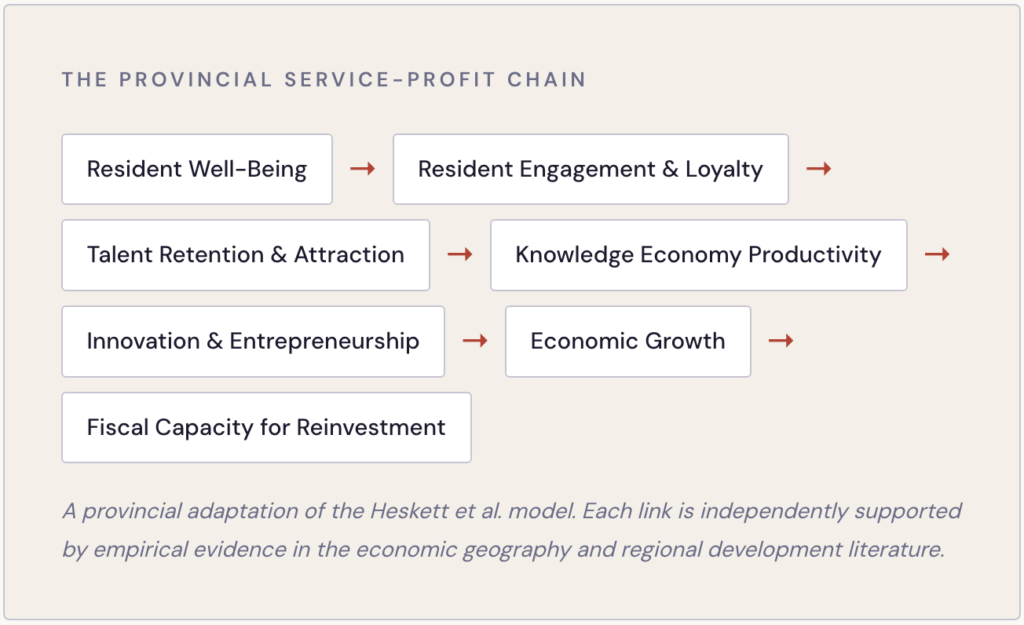
When residents are well — when they are housed, healthy, included, and connected to meaningful work and community — they stay. They build. They refer their networks. They start companies. They mentor the next generation. The province that creates these conditions doesn’t need to chase investment; investment follows the people, and the people follow the conditions.
The chain then runs: well-being produces loyalty and engagement; loyalty produces talent retention and attraction; retained and attracted talent drives knowledge economy productivity; productivity generates innovation and entrepreneurship; innovation and entrepreneurship drive growth; growth generates the fiscal capacity to reinvest in well-being. The loop is self-reinforcing, but it must be entered at the right point. Enter at “growth” — try to grow the economy directly — and you get the Industrial Estates Limited playbook. Enter at “well-being” — invest in the conditions that allow people to flourish — and you get something different.
What This Means for Policy
A Better Place proposes six goals for Nova Scotia’s next decade, and reading them through the service-profit chain lens, they cohere in a way that scattered sectoral strategies do not. They are, collectively, an argument for entering the chain at the beginning:
| → Make well-being the primary measure of public policy success. | Adopt a Nova Scotia-specific well-being framework — along the lines of the Canadian Index of Wellbeing or the OECD Better Life Index — as the primary instrument for measuring government performance. What we measure is what we manage. |
| → Solve the housing crisis as an economic imperative. | Housing unaffordability is not a social problem separate from economic development; it is the most direct threat to the province’s ability to attract and retain the people its growth depends on. Non-market housing, community land trusts, and aggressive supply support are chain-critical investments. |
| → Invest in placemaking as economic infrastructure. | Nova Scotia’s human-scaled, walkable communities are a competitive advantage that most of North America has spent 70 years destroying. Protect and develop them: pedestrian and cycling infrastructure, public gathering spaces, cultural institutions, rural broadband. These are not amenities; they are the internal quality environment of the provincial service-profit chain. |
| → Design for belonging. | A province that makes some people unwelcome — through discrimination, unaffordability, or cultural invisibility — is not a well-made place. The economic case for inclusion is as strong as the moral one: communities genuinely welcoming to newcomers, to racialized people, to LGBTQ+ residents, and to people with disabilities are more attractive to the mobile knowledge workers the economy needs. |
| → Extend the innovation ecosystem beyond Halifax. | The startup ecosystem emerging in the capital must be distributed across Cape Breton, the South Shore, the Valley, and rural communities. The service-profit chain works at the community level as well as the provincial level; every community that offers its residents genuine quality of place and economic opportunity retains its own talent. |
| → Measure, report, and iterate. | The service-profit chain only works as a management tool if you track the links. The province needs longitudinal data on resident well-being, talent retention and attraction, entrepreneurship rates, and innovation outputs — and it needs to report honestly on what the data shows. |
The Hardest Part of the Argument
The hardest part, when I tried to explain the service-profit chain to my partners back in 2009, was not the logic. The logic was easy. The hard part was the priority inversion it required: stop optimizing for the output and start optimizing for the conditions that produce the output. Stop asking what the clients need and start asking what the lawyers need. Trust the chain.
That inversion is exactly what provincial economic policy requires, and it is exactly what political economy makes difficult. Politicians are rewarded for visible outputs — ribbon cuttings, investment announcements, jobs numbers. They are rarely rewarded for the patient, compound work of improving the conditions under which residents live. Housing investments take years to show up in talent retention data. Placemaking investments take a generation to show up in innovation indices.
But the alternative — continuing to chase the output end of the chain while neglecting its beginning — is how Nova Scotia has spent most of its modern economic history. The record is clear: it does not work.
“The province that treats resident well-being as its primary economic investment — not a social spending category, but the foundation of its growth strategy — will win the competition for the talent that the knowledge economy runs on.”
The good news is that Nova Scotia is, in 2026, better positioned to make this argument work than almost any other jurisdiction in Canada. It has quality of place that cannot be manufactured. It has a population inflection that can be sustained or squandered. It has a housing crisis that is acute but not yet irreversible. It has an innovation ecosystem in its early, most malleable stage.
The question is whether its policymakers are willing to trust the chain — to invest upstream, in people and places and belonging, and let the growth emerge from those conditions rather than trying to engineer it directly.
A struggling law firm once taught me that this is how growth actually works in a knowledge economy. Nova Scotia’s history teaches the same lesson, in longer and more painful form. The only question is whether we’re ready to apply it.

