
By Peter Nicholson – June 23, 2026
This essay is the first in a trilogy inspired by the original short-form article, A Pipeline Isn’t a Field of Dreams, published June 29, 2026, on SAGE Canada | Substack. Read part two and part three.
The push for a major new pipeline connecting the oil sands to the British Columbia coast has become wrapped in larger symbolism—Is Canada committed to becoming an energy superpower? Are we still capable of building big? Does federalism work for Alberta? These are valid questions but their potent political symbolism has obscured the fundamental economic considerations that bear critically on the decision to build.
The purpose of this note is to step behind the rhetorical veil and examine whether or not the pipeline can be justified on commercial terms. Acknowledging various regulatory hurdles—which currently are the focus of almost all the public discussion—we should still ask whether there would be an economic case to build the pipeline even if every material regulatory impediment were removed. That is the fundamental threshold question given that the ultimate objective of the project, as stated by both the Alberta and federal governments, is to contribute to stronger provincial and national economies.
Filling a New Pipeline
Pipelines are not “Field of Dreams” projects. Before investors commit tens of billions of dollars, they need reasonable assurance that sufficient production will be forthcoming to utilize the pipe at commercially viable tolls over several decades. So the first question to be asked of any new pipeline proposal is the most basic: Where will the product come from to fill it? There are only two potential sources of supply for a new west coast pipeline, regardless of the route taken.
- Diversion — some product currently exported to the United States could instead be rerouted to Asian markets.
- Net new production — growth of oil sands output beyond the capacity of the existing and already planned pipeline network.
These two sources have very different implications. Diversion simply changes the destination of existing exports, whereas new production creates additional national income, jobs, royalties, tax revenue and export earnings. It’s new production that would generate the transformative economic gains foreseen by advocates of a new pipeline. The key question is whether oil producers see sufficient commercial benefit —through diversion or new production — to justify paying the tolls that would be needed to cover the high cost of new pipeline construction and operation, all in the context of cheaper alternatives into the United States.
A pipeline capable of carrying roughly one million barrels per day to the B.C. coast—the volume assumed in most public discussion—would cost tens of billions of dollars, particularly if routed northward through difficult terrain to a new marine terminal. As a cautionary tale, the final cost of the Trans Mountain Expansion (TMX) exceeded $34 billion despite following an existing right-of-way to an already established terminal. A southern route, parallelling TMX, would be less costly but would face the thorny problem of substantially expanding shipping capacity in the congested Vancouver area.[1]
The federal government is encouraging economic diversification generally from what is seen as excessive dependence on the United States, currently the destination of approximately 90 per cent of Canada’s oil exports. Oil producers also value alternative market access to the extent that Asian sales may yield somewhat higher net income per barrel and/or induce competitive prices from U.S. customers. The current debate often blurs two separate questions:
- Would the pipeline make commercial sense for the industry expected to finance and fill it?
- What would be the strategic value of the pipeline for Canada and/or Alberta?
If the answer to the first question is “no” then governments would need to decide if the subsidy needed to actually have the pipeline built would nevertheless be justified in light of the answer to the second question. This is the right framing in purely conceptual terms while recognizing that the answers in each case depend critically on many economic and political imponderables.
Demand for, and Supply of, New Pipeline Capacity
Regarding question (i) above from the perspective of an oil sands producer—How much need for new export pipeline capacity can reasonably be foreseen? The oil sands industry increasingly emphasizes “brownfield” expansion — i.e., incremental production growth from existing projects — rather than large new greenfield developments. Industry and analyst estimates suggest that existing operations could plausibly increase production by roughly 500,000 barrels per day over time through optimization, debottlenecking, solvents and related improvements—see for example the latest long-term projection by the Canada Energy Regulator described later in this note.
What about pipeline capacity to carry this incremental production? The TMX system already has nominal capacity of 890,000 barrels per day and is now essentially fully utilized. But the operator has recently stated that the capacity can be increased by another 300,000 barrels per day as early as 2028 through technical measures such as drag-reducing agents and greater pumping power. This would bring capacity close to 1.2 million barrels per day.
Meanwhile, additional U.S.-bound pipeline expansions that are under advanced consideration could add a great deal more capacity.
- Enbridge is pursuing low-cost expansions of its existing U.S.-bound network. The approved Mainline Optimization Phase 1 will add 150,000 barrels per day (b/d). The company is also advancing a second optimization phase that could add a further 250,000 b/d by as early as 2028, primarily to move Western Canadian crude to the U.S. Gulf Coast. Together, these projects would transport an additional 400,000 b/d into the same North American refining system that already handles most oil sands exports.
- Plans are also advanced for South Bow’s “Prairie Connector” pipeline that would initially be able to deliver 450,000 b/d to the US Midwest and Gulf coast. That 1,000 kilometer line would use steel left over from the cancelled Keystone XL project and is reported to have already secured sufficient oil producer commitments to proceed.
To recap the demand and supply arithmetic—If anticipated oil sands expansion eventually adds roughly 500,000 barrels per day, and expanded TMX infrastructure could absorb roughly 300,000 barrels per day more than currently, the remaining unmet requirement for bitumen transport would be on the order of 200,000 barrels per day. While this is a rough estimate, it’s far short of the million barrels a day capacity envisioned for a new pipeline to the BC coast. Consider furthermore that the large volume of U.S.-bound pipeline projects already under active consideration could absorb considerably more than the residual volume not carried by an upgraded TMX. In summary: the new capacity that can be expected in the near term from TMX, Enbridge, and South Bow would total roughly 1.15 million b/d. So where is the demonstrated need for a new million b/d pipeline to the coast?[2]
The acid test for a new west coast pipeline will not be an expression of intent in a proposal document to the federal Major Projects Office, but rather the explicit commitment by producers to future shipping volumes over 20 years or more. Without substantial long-term contractual commitments, a pipeline remains a concept rather than a commercially financeable investment.
Filling a Pipeline: Diversion or New Production?
From the standpoint of oil producers a new million barrel per day west coast pipeline becomes commercially compelling only if one or both of two conditions holds. Either:
- The value of market diversification via diversion from the U.S. to Asia is large enough to justify shifting massive existing volumes into the new line despite the tolls needed to cover its cost; and/or
- Producers foresee very significant additional greenfield oil sands development beyond currently anticipated growth—something approaching a million barrels per day of additional production.
Regarding further large-scale diversion—Once the Trans Mountain expansion entered service in mid-2024, Canadian producers gained access to Asian markets although the shipments, mostly to China, have been less than to the U.S. coast. For example, in Q4, 2025, TMX averaged 807,000 b/d of which about 46% went to the US, 42% to Asia, and 12% remained in BC. It may come as a surprise that TMX is as much another connection to the U.S. oil market as it is a link to Asia. The extra economic benefit of additional access to Asia would be the increased bargaining power created by having a larger share of Canadian production able to choose between Asian and North American markets. But it’s very unlikely that the incremental net gain would be nearly large enough on its own to justify the cost of a new million b/d pipeline particularly since TMX, with planned upgrading, already provides a great deal of bargaining leverage at the margin. Moreover, substantial further diversion from existing U.S.-bound systems would create its own complications. Transportation commitments, integrated refining relationships and pipeline utilization economics limit the degree to which large volumes can simply be shifted without significant consequence.
A new pipeline would also possess what industry strategists call “option value”—i.e., the flexibility to cope with uncertain future circumstances. For instance, a new pipeline would provide some extra protection against competitive displacement in the U.S. market, or against hostile U.S. policy. While the latter risk is a concern as long as Donald Trump is President, the present administration has not sought to disadvantage oil imports from Canada. And over the long timeframes for pipeline investment it’s reasonable to assume there will be a businesslike approach by the U.S. to energy trade. The more realistic risk is market competition from alternative heavy crude suppliers, particularly if Venezuelan production eventually recovers substantially, but at best this would take many years.
The problem is that option value—extra capacity just in case it may be needed—comes at a potentially severe cost since the economic viability of a pipeline depends on close to full utilization. Otherwise toll rates must increase very significantly as usage declines.[3]
So, from a producer’s perspective, the likelihood is that the benefits of substantial additional diversion from the U.S. market, plus insurance against political and competitive risk, would not come close to justifying the very large cost of a new west coast pipeline. But the project might still make commercial sense if producers were to commit to major new greenfield oil sands development—on the order of an extra million barrels per day beyond what optimization of existing facilities is expected to deliver. Is there a business case?
Prospects for Major New Oil Sands Development
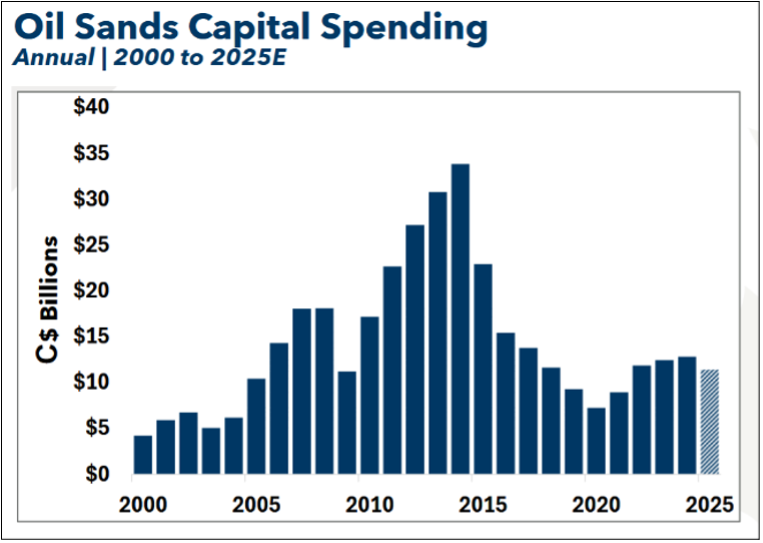 New oil sands production requires enormous upfront capital investment. Between 2000 and 2017 the chart shows that approximately C$275 billion was invested in new capacity, peaking at $34 billion in 2014. This prodigious investment currently produces about 3.6 million barrels of bitumen per day. While many factors would bear on the capital cost of new greenfield development, a million barrels-per-day pipeline would require investment in new oil sands production of probably well over $50 billion and potentially approaching $100 billion.[4] A major new round of upfront investment in greenfield production—on strictly commercial terms—will only occur if the industry has confidence in robust oil demand at compensatory prices extending decades into the future. Yet the outlook increasingly points in the opposite direction.
Most credible forecasts now anticipate that global oil demand will either increase very slowly or eventually gradually decline. The 2025 World Energy Outlook from the International Energy Agency (IEA) presents two scenarios—labeled Current Policies (CPS) and Stated Policies (STEPS)—that project global oil demand forward from 100 million barrels per day in 2024.[5] In 2035 the projected demand lies in a narrow range between 100 (STEPS) and 106 (CPS) million barrels per day, and by 2050 in a somewhat broader range, between 97 and 113 million. As to where the oil will come from in the future, it’s significant that in both scenarios there is increased supply from the OPEC+ group of countries and long-term decline from the rest, collectively, which includes the US, Canada, Western Europe, among others.[6] Thus even increased global oil demand does not automatically imply a growing market for Canada.
China, which is the main non-U.S. destination for the oil carried by TMX, is currently the world’s largest oil importer but also the most aggressive deployer of electric vehicles, batteries, renewable power and industrial electrification. The IEA projects that China’s oil demand will actually decline slightly by 2035. While this will likely be offset by increased demand in India, as well as other developing regions in Asia and Africa, the march of electrification is virtually certain to put a low ceiling on the growth of oil demand. The recent disruption of shipment through the Strait of Hormuz also underlines the risk of dependence on imported oil and will almost surely accelerate the deployment of wind, and especially solar energy, the cost of which continues to fall.
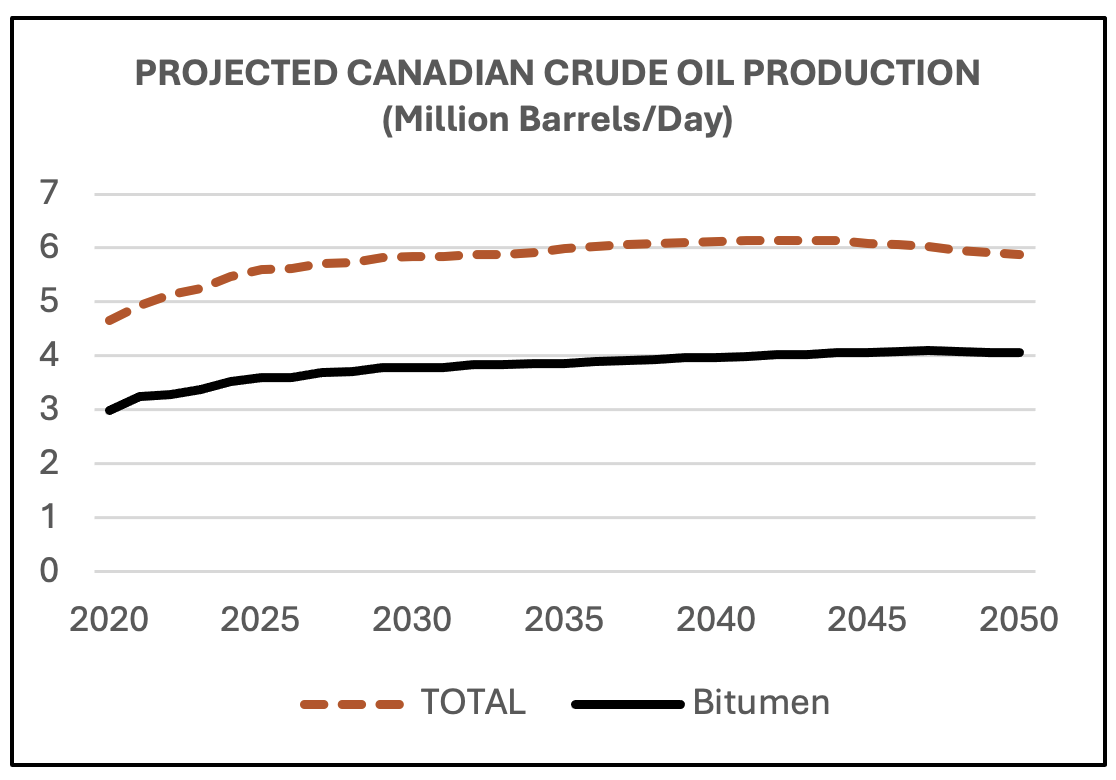 Narrowing the context to Canada, the chart portrays the latest long-term projections from the Canada Energy Regulator (CER), tracing total crude oil production (dotted line) and bitumen in the CER’s “Current Measures” base-case scenario. Bitumen production, at more than 60% of the total, is projected to increase from 3.6 million barrels per day in 2025 to 3.9 by 2035 and then remains approximately flat at slightly more than 4.0 through 2050. This suggests an eventual increase of between 400,000 and 500,000 barrels per day above current production. Although the projection obviously depends on a great many assumptions, it reflects the current state of expert knowledge as of late 2025 and is broadly consistent with other forecasts of bitumen production and with the IEA’s outlook for global oil demand. While there will certainly be no sudden collapse in oil demand, it’s almost certain that growth will become much slower and more uncertain.
A producer contemplating a multi-decade oil sands megaproject must not only forecast how much oil is likely to be consumed over the next several decades, but also whether prices in a slower-growth market will remain high enough to justify very large new upfront investment. The key point is that once producers believe that global demand has peaked, or is even approaching a plateau, oil market dynamics change fundamentally. The dominant strategic logic becomes preservation of market share. This means that countries with the largest reserves and lowest marginal production costs — particularly the Gulf States — have every incentive to continue producing aggressively while cutting price rather than to leave profitable oil in the ground. Saudi Arabia, the UAE, Russia, and others can produce oil at costs well below those of new oil sands megaprojects.
Today’s Oil Sands: A Mature Cash Generator
It’s very likely that most of the existing Canadian oil sands projects can remain profitable for many years to come. That’s because their upfront capital costs have already been incurred and financed; production decline rates are low; and operating costs for most projects are competitive. The facilities will continue to operate as long as their non-fixed cost is covered.[7] The oil sands sector has effectively become a mature industry generating a reasonably reliable stream of cash, dividends, royalties, and taxes, all varying with the rhythm of global oil prices. A recent publication from the Canadian Association of Petroleum Producers includes the following revealing statement:
“Instead of more costly greenfield development projects, oil sands operators have instead focused on brownfield development of existing assets as well as optimization and de-bottlenecking opportunities.”
The industry’s actual capital allocation behaviour is consistent with this assessment. During the past decade, major producers have increasingly emphasized debt reduction, dividends, and share buy-backs. Only one greenfield oil sands project has been built since 2013. In view of authoritative global oil demand forecasts that project at most modest growth, the industry’s behaviour is commercially rational. U.S.-based producers have adopted similar strategies although in the context of production via fracking.
Economic Logic Versus Political Logic
Despite the logic of the industry’s conservative business strategy, oil sands executives nevertheless argue publicly that the incentive for private investment in greenfield production has been severely undermined by federal policy, and particularly by Ottawa’s insistence on large-scale carbon capture and storage (CCS) as a condition for approval of a new pipeline to the B.C. coast. In a June 9 speech, the CEO of Cenovus, Jon McKenzie, was crystal clear regarding the industry’s position: “It will be an imperative to remove the regulatory obstacles that today prevent a private sector proponent from stepping up to take on the development and construction of the pipeline.”
In 2022, the industry’s “Pathways” initiative proposed an ambitious CCS megaproject at a time when emissions reduction was seen to be a top global and national priority. Since then the industry’s enthusiasm has evaporated at the same time as Ottawa has insisted that CCS investment is required if a new bitumen pipeline is to be built.[8] Reacting to the May 15th federal-Alberta Implementation Agreement, Kendall Dilling, president of the Oil Sands Alliance stated that: “The Alliance is committed to advancing the Pathways project provided the necessary regulatory and fiscal terms are in place to support the project and new oilsands growth in Canada. An industrial carbon tax only adds uncompetitive costs to industry on top of the costs of a carbon capture project.”[9]
Left unsaid is precisely the fiscal terms that would be needed “to support the project and new oilsands growth.” The federal government has already promised an investment tax credit for CCS projects and the Alberta government also has a CCS capital incentive program. Whether these inducements will be enough to bring Pathways to fruition—a project without revenue and a cost estimated to be $20 billion for Phase 1—remains to be seen. There is also an implication in Mr. Dilling’s statement that taxpayer assistance may be needed to encourage the “new oil sands growth” needed to fill the proposed pipeline, an implicit acknowledgment that the commercial incentive for greenfield development is weak.
As things stand now, the potential pipeline project is being held hostage by Ottawa’s carbon capture requirement thus allowing Alberta and industry leaders to argue that federal climate conditions are the reason no commercially viable pipeline proposal has yet emerged. That argument is politically powerful and puts great pressure on Ottawa either to relax the CCS requirement or provide sufficient fiscal support to make Pathways and a new pipeline economically attractive. Again to quote Jon McKenzie: “Without policy and regulatory reform that provides a framework for production growth, neither the Pathways Project nor the West Coast Pipeline make any sense.”
But suppose Ottawa were to relax or eliminate the CCS requirement. Producers would still face the same underlying commercial realities— modest projected growth (or decline) in global oil demand; the very large upfront cost of greenfield oil sands development; increasing competition from low-cost producers if global oil demand falters; and the existence of lower-cost transportation alternatives through expansion of TMX and additional U.S.-bound pipeline capacity. Would producers nevertheless be willing to make the long-term commitments needed to support private financing of a new pipeline? Based on the evidence assembled in this note, the answer is probably not.
The irony is that federal climate and regulatory policies may ultimately serve as politically convenient scapegoats for a project whose underlying economics are already weak. Yet because Alberta has succeeded in elevating the “pipeline” into a potent symbol—particularly in the context of a nascent separatist movement—there is intense pressure on Ottawa either to somehow enable the project or else bear the blame for its failure. Indeed, the debate does not appear to be primarily about the pipeline itself. For the Alberta government, the project has become a symbol in a broader negotiation over climate policy, regulatory approvals, and the broad front of federal-provincial relations. The pipeline affords leverage. This would explain why the political intensity of the issue has become disproportionate to the underlying commercial prospect.
One response available to Ottawa would be to effectively call the industry’s bluff by removing the CCS requirement for this particular project.[10] Such a move would obviously generate a great deal of controversy. But if the industry were still unwilling to proceed with the pipeline on commercial terms, Ottawa’s project-specific concession would at least not have adverse environmental consequences since there would be no new pipeline.
The alternative approach would be to provide enough direct and indirect fiscal support—further subsidy for Pathways, loan guarantees, public equity participation, or some combination of these—to enable the pipeline to proceed despite the absence of a compelling commercial case. But unless there were to be major new greenfield oil sands development—an outcome that is commercially unlikely—the pipeline would remain underutilized and the ultimate fiscal cost could be enormous.
The Global Energy Future
Meanwhile, the global energy system continues to evolve toward the electrification of everything that can reasonably be electrified. For reasons of cost, energy security, public health, and climate sustainability, electricity generation itself is increasingly shifting toward solar, wind, hydro, nuclear and other low-emission sources. Because this transition will take decades to complete, fossil fuels will continue to play an important bridging role. But the related growth opportunities favour natural gas rather than oil.
Alberta’s oil sands will nevertheless remain a significant producer for decades and oil exports will remain important for Canada’s trade balance and exchange-rate stability. But it’s unrealistic to expect Canada to become a greater energy superpower through massive new oil sands expansion.
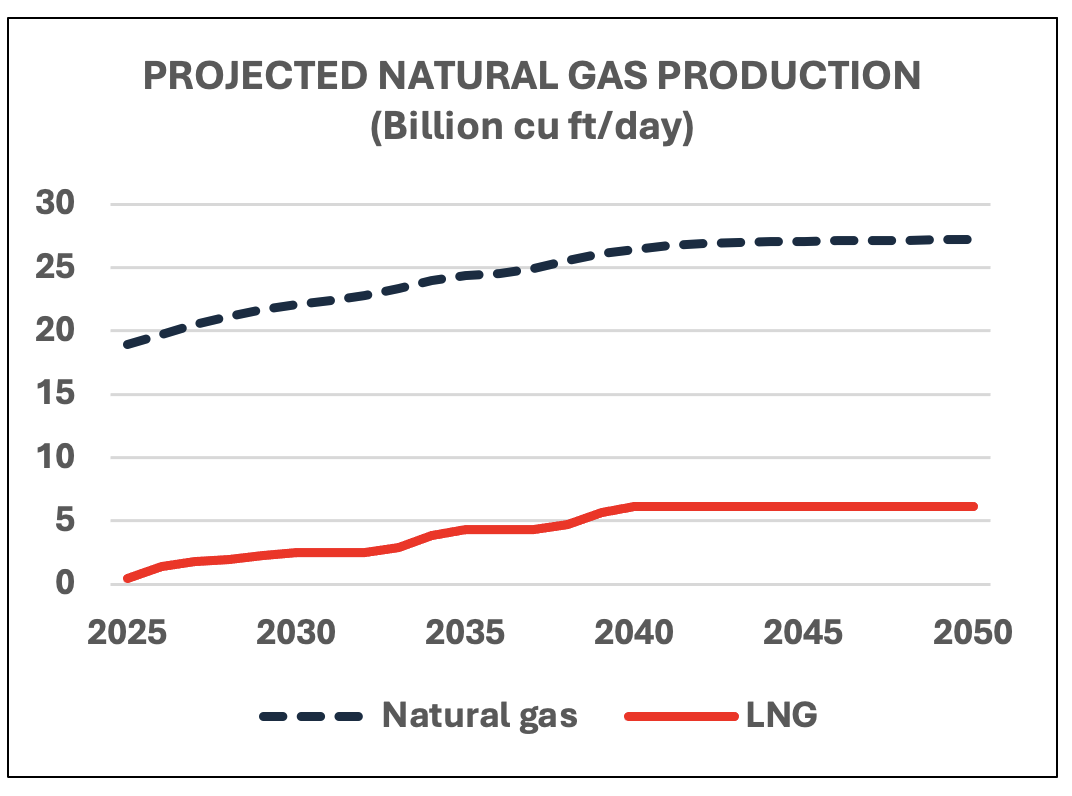 The more plausible mid-term growth story lies in natural gas and its liquefaction as LNG. (The chart traces the CER’s latest projection of Canadian gas production under its Current Measures scenario.) Unlike oil, global LNG demand appears to have substantial room for expansion as countries seek to replace coal in electricity generation and industrial heating. Canada possesses one of the world’s great gas resources in the Montney formation straddling Alberta and British Columbia.[11] Competition in the LNG market will be fierce, particularly from the United States. But unlike the proposed new oil pipeline, LNG export infrastructure is already attracting large-scale private investment—e.g., LNG Canada, together with several other projects now planned or under construction, demonstrate that private capital sees a compelling opportunity in exporting Canadian gas to Asia.[12] That fact speaks more loudly than any political slogan about the economic future of Canada’s fossil energy resources.
There can be no doubt that Canada needs urgently to improve its capacity to build major projects quickly and competently. Energy infrastructure remains an essential part of that agenda. But national ambition does not eliminate the need for commercial discipline. The purpose of strengthening Canada’s project-building capacity is to support investments justified by long-run economic value, not by political symbolism.
Under any reasonably foreseeable market conditions, the evidence presently available does not support an economic case for a new bitumen pipeline to the Pacific coast.
Endnotes:
[1] It is beyond the scope of this note to examine the choice between a northern versus a southern route. Each would be problematic and costly. The focus of the analysis here is the source of product for the pipeline, whatever the potential route.
[2] The volume of bitumen produced (in b/d) cannot be equated one-for-one with the corresponding transported volume in a pipeline since diluent must be added before raw bitumen can be carried, and this results in a greater volume of “dilbit” than that of the input bitumen. The volume increase can be up to 30%. Dilution is not required if the bitumen is first upgraded to synthetic crude. But even given the dilbit expansion factor, the existing and planned pipeline capacity considerably exceeds what would be needed to accommodate the foreseen future oil sands production from existing projects.
[3] For example, if the volume carried were reduced by 25% below capacity, the toll rate would need to increase by a third (other things being equal) in order to generate the original cash flow. If the reduction were 50%, the toll would need to double under these circumstances.
[4] Based on cumulative past investment (2000-2017) and current annual production, a simple back-of-the-envelope calculation indicates that to produce a million barrels per day entails an investment on the order of $75 billion ($275B/3.6). Going forward this figure could be lower thanks to factors like improved technology, existing infrastructure, and cumulative experience; but might also be greater due to general inflation, supply chain constraints, and potentially less favourable geology.
[5] The CPS is based on policies and regulations already in place and maintains a cautious perspective regarding the speed at which new technologies are deployed. The STEPS includes policies that have been put forward formally but not yet adopted. Barriers to the adoption of new technologies are assumed to be lower than in the CPS but STEPS does not assume that aspirational targets (e.g., net-zero emissions by 2050) are met.
[6] OPEC + includes the formal members of OPEC (largely Middle Eastern and African countries) as well as several others including Russia, Brazil and Mexico.
[7] The break-even WTI price per barrel varies considerably from project to project and has been estimated to range between roughly US$18 and $45 with an overall average of $27.
[8] On May 15, 2026 the federal and Alberta governments concluded an Implementation Agreement (following a November 2025 Memorandum of Understanding) which included the following: “Canada and Alberta reaffirm that construction of the oil pipeline project and construction of the Pathways Project are mutually dependent.”
[9] The industrial carbon tax imposed under Alberta’s updated TIER system is estimated to cost only roughly 50 cents per barrel of bitumen and clearly is not a significant impediment to investment in new production. The cost of carbon capture, transport, and storage is another matter altogether.
[10] A separate issue is the federal “tanker ban” which prevents an oil pipeline terminating anywhere north of Vancouver Island, and would thus rule out the northern pipeline route favoured by the Alberta government.
[11] Already proven reserves in the Montney formation can be produced at globally competitive cost and are approximately 450 trillion cubic feet, equivalent to 60 years of Canada’s 2025 total natural gas production.
[12] For example, TC Energy and LNG Canada reached commercial agreements in 2026 to support a potential Phase 2 expansion of Coastal GasLink, doubling the pipeline’s capacity to support LNG Canada’s Phase 2 expansion decision. There are several other proposed projects to move gas to LNG terminals, in each case subject to firm commercial commitments to the shipping volumes needed to justify expansion.
Three-part series:
Does Canada Need A New Oil Pipeline to the BC Coast?
From Economics to Politics
Carbon Capture and the Pipeline

