
Build Canada Strong for whom? An examination of the Air Canada microcosm, section 36 of the Canadian Constitution, and forty-five years of gains that did not reach the people who earned them
By Bernard F. Miller KC, ICD.D
On April Fool’s Day, 1981, my father stood at a podium in Montreal and opened with a joke at his own expense. After years of attending the McGill University Industrial Relations Centre’s annual conference from the audience, he told the room he now found himself at the microphone on the first of April, and he was not sure whether the joke was on him or on them. Someone had suggested to him just before he began that the real joke was a Crown corporation lecturing anyone on productivity or labour relations.
His name was also Bernard F. Miller. He was Vice President, Personnel, at Air Canada, and his paper carried an urgent title: Productivity or Perish. It was published later that year in the conference proceedings, The Productivity Crisis and Labour Relations, edited by Professor Frances Bairstow. He proposed to treat Air Canada as a case study because, in his words, it was “a microcosm of Canadian society,” employing Canadians of all ages and backgrounds in every major city, every region and every province, in both founding cultures and the many others that make up Canadian life. The pressures bearing down on the airline, he argued, were not dissimilar to those confronting the country as a whole.
He closed with a promise. He looked forward, he said, to returning to the conference in 1990 with a new title: “How Air Canada Prospered During the Turbulent 1980’s.”
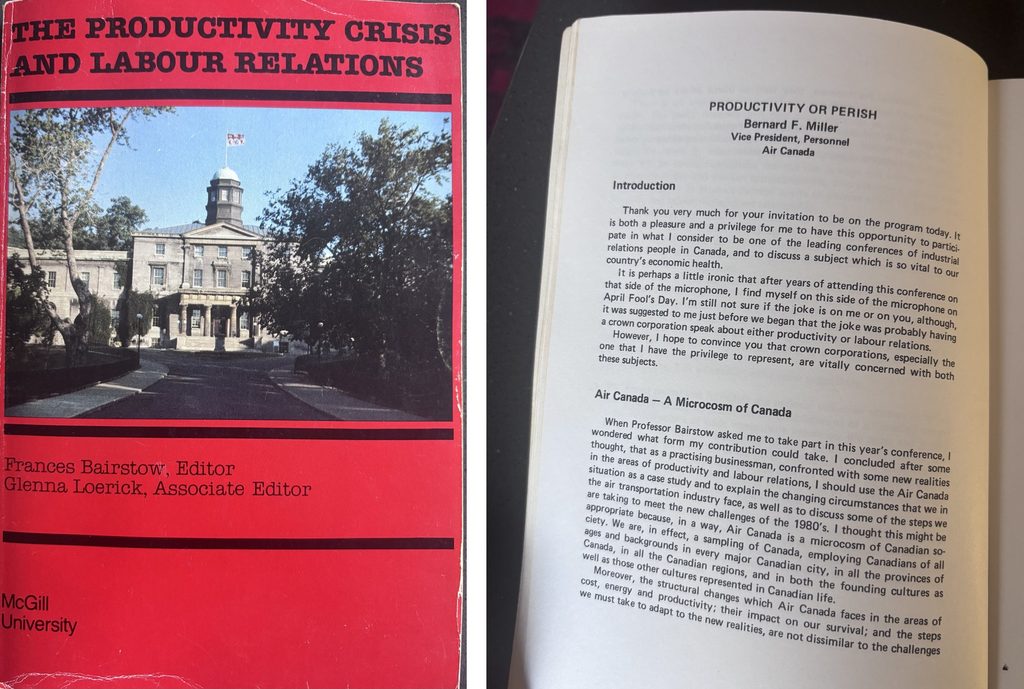
This essay is the sequel he did not write, forty-five years on. I have borrowed his title and changed one word. His argument was that Air Canada, and Canada, had to choose: become more productive or perish. In the decades that followed, we got both: productivity, and the risk that Canadian social cohesion may perish. Air Canada became far more productive, and so did Canada. But the second half of the bargain he described, the half that promised security, fair sharing and a real voice for the people who produced the gains, was allowed to wither. The productivity survived. Much of what it was meant to support did not. With high levels of homelessness, addiction, deaths of despair, popular dissatisfaction, populist movements and a renewed risk of separatism that could cause the nation itself to perish, the ‘and’ rather than the ‘or’ is justified.
My thesis is simple. For more than four decades, Canadian economic policy has pursued productivity growth relentlessly while neglecting the purpose that the Constitution assigns to it. Section 36 of the Constitution Act, 1982, written into our supreme law in the same months my father was writing about Air Canada, commits Canadian governments to promote equal opportunities for the well-being of Canadians and to further economic development in order to reduce disparity in opportunities. Productivity was meant to be the means. Too often, it became the end. The gains were captured disproportionately by investors, executives, professional advisors and essential credentialed workers, while large parts of the workforce were left in precarious positions. The result is a society that is richer on paper and more fragile in fact.
Air Canada is once again a useful microcosm. This is not an essay about villains. Most of what happened at the airline after 1981 was lawful, much of it was rational, and some of it preserved the solvency of the company and, ultimately, shareholder value. But at every critical juncture, from privatization through restructuring, pension relief, pandemic aid and the return of capital that followed, the interests of shareholders were placed ahead of those of employees and communities. That, in microcosm, is the issue. The point is what the rules rewarded, and what that tells us about the country today, at this key moment in Canada’s history.
1. The Bargain of 1981
The Air Canada of 1981 was a Crown corporation whose common shares were held by the Minister of Transport on behalf of the Canadian people. It employed about 23,000 people, 75 percent of them in one of twelve unions. It had annual sales of about $2.25 billion, a payroll of about $650 million, and pre-tax income in the range of $100 million a year. It operated on commercial principles, borrowed in the money markets without a government guarantee, and financed its future from its own profits. In the first nine months of 1980, its operating income of $121.1 million led every major North American carrier in its comparison, while Eastern, Continental, Northwest, Western, Pan American, Braniff, American and United were all losing money.
The airline was not in trouble. But my father could see the storm coming. Fuel that had cost Air Canada about $30 million in 1970 would cost more than $1 billion by 1983. Interest rates had roughly tripled since 1973. Deregulation in the United States had pushed several major carriers toward bankruptcy, and it was arriving in Canada at a slower pace. Most importantly, the industry’s free ride was over. For decades, each new generation of aircraft had absorbed rising costs with a leap in capacity. A Super Constellation could carry about 22,000 passengers a year between Vancouver and Toronto; a Boeing 747 could carry 313,000. No aircraft on the horizon could repeat that leap. Productivity would now have to come from people and organization, not from engineering alone.
His answer is the heart of this essay. He argued that every organization holds a “hidden reservoir” of productive capacity, and that it is unlocked only when employees understand the challenge, trust one another, feel fairly treated and have a real say in how the organization operates. In an organization where people feel like a number, feel exploited, and experience their work as drudgery, the reservoir stays locked. He thought most Canadian industrial workers felt closer to the second condition than the first.
He also challenged the class assumptions of his own side of the table. In an era of widely diffused ownership, he argued, the line between management and labour was overdrawn. Everyone in a large organization was a salaried employee seeking respect, dignity, fair compensation and worthwhile work. “Why should one group of salaried employees play the role of the robber barons,” he asked, “while another group plays the role of downtrodden workers?”
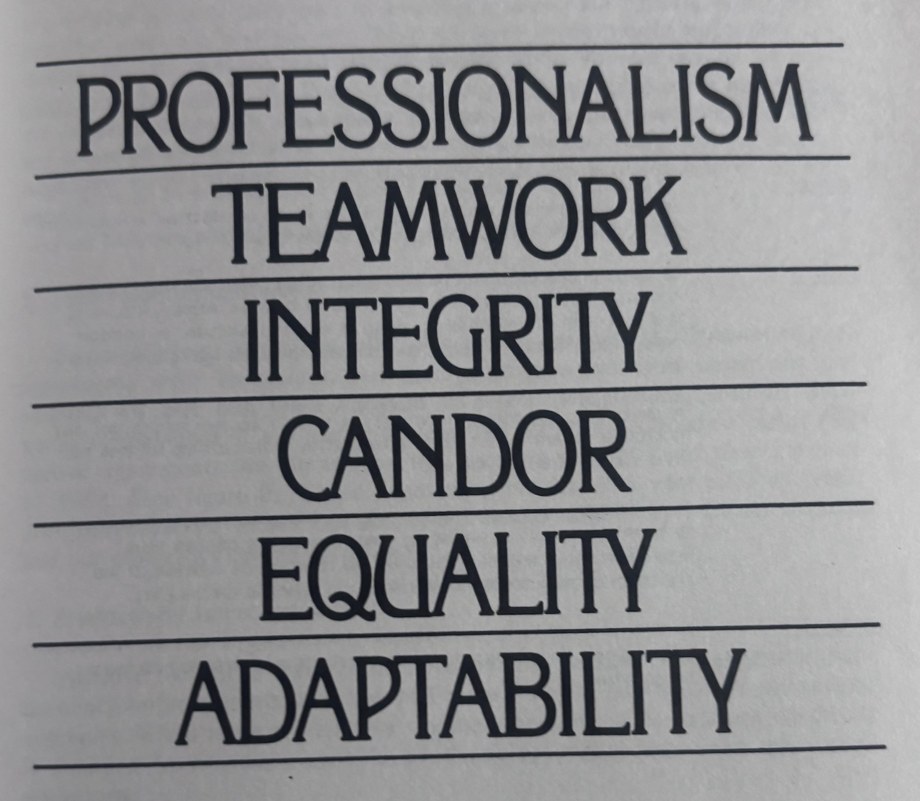
The program that followed from this was concrete. Air Canada’s senior executives committed the company to six operating principles: professionalism, teamwork, integrity, candour, equality and adaptability. The equality principle committed management to the best interests of all employees, to the dignity of their varied roles, and to the legitimacy of their desire for meaningful and rewarding working lives. Negotiations were to shift from confrontation and “poker playing” to problem solving, with all parties emerging with a fair sharing of the economic pie. The company was working on policies for profit sharing, stability of employment and employee participation in decision making. Unions, for their part, were prepared to negotiate productivity improvements in return for job security. Over the fifteen months before the conference, Air Canada signed fifteen collective agreements, all but one in direct negotiations.
Flexibility was part of the bargain from the start. In 1981 it was paired with a commitment to stability of employment and a fair share of the gains. The bargain had two halves. Productivity was one. Sharing was the other.
My father was speaking at a hinge in economic history, and Peter Drucker, the most influential management thinker of the century, would later describe it precisely. In “The Age of Social Transformation,” published in The Atlantic Monthly in 1994, Drucker observed that the systematic study of manual work, beginning in the 1880s, had raised the productivity of workers making and moving things by three to four percent a year for more than a century, a fiftyfold increase, and that all the economic and social gains of the industrial age rested on it. Those gains had been shared: by mid-century, unionized industrial workers enjoyed job security, pensions and a political voice that no working class had ever held. Drucker also insisted that management is a social function, not merely a set of techniques. My father’s paper was written in that tradition. He was arguing for a bargain that the industrial era had made possible, at the very moment the industrial era was ending.
In the same months, Parliament was debating the resolution that would become the Constitution Act, 1982. I doubt my father had section 36 in mind when he wrote his paper. But the two documents rest on the same premise: productivity and growth are instruments, and the test of their success is whether the people who produce them share in the result.
2. The Productivity Came
On its own terms, my father’s prediction came true. Air Canada did not perish. Of the ten American carriers in his 1980 comparison, seven- Eastern, Pan American, Braniff, TWA, Western, Northwest and Continental- no longer exist as independent airlines. Air Canada survived deregulation, the absorption of Canadian Airlines in 2000, a court-supervised restructuring, a pandemic that grounded most of its fleet, and in 2026, a fuel shock that echoes the one he described.
It also became dramatically more productive. In 2025, Air Canada carried 45.3 million passengers and earned record operating revenues of $22.4 billion, with a workforce of about 36,000. Adjusted for inflation, its revenue has roughly tripled since 1980, while its workforce has grown by about half. It was named the best airline in North America at the 2025 Skytrax World Airline Awards. Whatever else is said in this essay, those are real achievements, earned by the people who work there.
The question is not whether the gains were made. It is where they went.
3. Where the Gains Went
The story of Air Canada since 1981 can be told as a series of decisions, each defensible on its own terms, that together moved the gains from one half of the bargain to the other.
Privatization, with promises
Parliament passed the Air Canada Public Participation Act in 1988. An initial public offering followed that October, and on July 19, 1989, the federal government completed the sale of its remaining shares. Both major parties had contemplated privatization. The statute did not simply release the airline; it attached public obligations, including a requirement to maintain operational and overhaul centres in Winnipeg, Montreal and Mississauga. Those promises were the public’s half of the new bargain.
Restructuring, and who paid for it
On April 1, 2003, twenty-two years to the day after my father’s speech, Air Canada filed for protection under the Companies’ Creditors Arrangement Act. The restructuring was real, and it saved the airline. It was also paid for largely by employees. By the account of Robert Milton, who led the airline through the process, employees made $1.1 billion in concessions, including an extension of the period for funding pension shortfalls.
What came next is instructive. A new holding company, ACE Aviation Holdings, was created as Air Canada emerged in 2004. Over the following years, ACE spun off or sold the airline’s loyalty program, Aeroplan, its regional carrier, Jazz, and its maintenance division, Air Canada Technical Services, renamed Aveos. When ACE sought to wind itself up in 2009, with Air Canada’s pension plans facing a solvency deficit of $2.9 billion, the airline’s five unions publicly asked the pension regulator to require ACE to fund the plans first. They pointed out that ACE shareholders had received $2 billion from the sale of Air Canada group companies since 2004, and that ACE’s chief executive had received $42 million in compensation. Those are the unions’ figures, not an audited account, but the direction is not in dispute. The value created by the restructuring flowed outward to investors while the risk remained with employees and the pension plans.
The promise that was not kept
Aveos closed in March 2012. More than 2,600 skilled maintenance jobs in Montreal, Winnipeg and Mississauga disappeared. Air Canada maintained that it remained in compliance with the 1988 statute. Quebec’s Superior Court ultimately disagreed, finding in 2022 that the airline had violated the Act by failing to keep the three centres operating; the airline appealed, and a class action on behalf of about 2,200 former workers followed. In the meantime, in 2016, Parliament amended the Act to loosen the maintenance obligation. The public half of the 1988 bargain proved easier to change than to enforce.
Pension relief, then buybacks
By 2012, Air Canada’s pension solvency deficit had reached $4.2 billion. Ottawa granted funding relief by regulation, and the relief came with a condition that matters for this essay: while it applied, the airline could not pay dividends or buy back its shares. Markets recovered, interest rates rose, the airline’s investment strategy changed, and by 2014 the plans were in surplus. Air Canada then opted out of the relief regulations and announced that more than $1 billion in planned deficit payments would be redeployed toward share buybacks, debt repayment and new aircraft. The pensions were secured, which is a genuinely good outcome for plan members, including my mother, who is the surviving beneficiary of my father’s defined benefit pension. But the moment the public’s support ended, so did the restriction on returning capital to shareholders.
A decade of restraint
Through much of the following decade, the airline’s largest groups signed unusually long agreements. Pilots accepted raises of 2 percent a year over ten years. Flight attendants signed a ten-year agreement in 2015. Both were sold as instruments of labour peace and stability, and stability has value. But when the agreements expired, the gap was visible. The pilots, who hold scarce skills and the power to ground an airline, won a cumulative increase of nearly 42 percent over four years in 2024, which their union described as restoring what pilots had lost over two decades. The flight attendants, about 10,000 people, most of them women, told a different story. Their union reported that a full-time entry-level flight attendant earned about $27,000 a year, and that entry-level wages had risen by about $3 an hour since 2000. Part of the reason was structural: flight attendants were paid for time in the air, not for boarding, safety checks and the other duties they performed on the ground.
The pandemic, and the conditions that expired
In 2020, as travel collapsed, Air Canada announced it would cut about 20,000 jobs, roughly half its workforce. In April 2021, the federal government agreed to a support package of up to $5.9 billion, including a $500 million equity stake. In exchange, the airline agreed to refund cancelled flights, restore regional service, maintain staffing levels, and cap executive compensation at $1 million. Weeks later, it emerged that the airline had paid about $10 million in bonuses for 2020 while negotiating the package. After the Minister of Finance called the bonuses inappropriate, the top five executives returned theirs; most of the program, paid to middle managers, was not returned. In November 2021, Air Canada cancelled the unused government credit line, and with it the compensation restrictions. In 2022, the chief executive’s total compensation was $12.38 million.
Record revenue, record returns
By 2025, the pattern was complete. Air Canada spent more than $850 million buying back its own shares that year, including a $500 million substantial issuer bid, and repurchased more than $140 million more in the first quarter of 2026. The chief executive’s total compensation for 2025 was $13.1 million, including a bonus that rose 43 percent.
That figure is worth setting beside the airline my father described. In 1981, Air Canada was a Crown corporation, and the pay of its president was fixed by the federal government within the salary ranges set for the heads of Crown corporations. I have not found the precise figure. But my father, as a vice president, earned a little over $100,000 a year, and a reasonable estimate for the president is in the range of $150,000 to $200,000, or about $175,000. Adjusted for inflation, which has multiplied prices by roughly four and a third since 1981, that is about $750,000 in today’s dollars. The chief executive’s 2025 compensation of $13.1 million is about seventy-five times the 1981 figure in nominal terms and about seventeen times in real terms. Over the same period, the average Canadian worker’s weekly earnings rose from about $350 to about $1,300, a real increase of less than one-fifth. In 1981, the head of the national airline earned roughly ten times the average Canadian wage. In 2025, the chief executive earned roughly two hundred times. The airline did not become twenty times larger in real terms, and the job did not become twenty times harder. What changed was the rule for dividing the gains.
In August 2025, the flight attendants struck. More than 99 percent had voted to authorize a strike. The federal government invoked section 107 of the Canada Labour Code less than twelve hours after the strike began, and the Canada Industrial Relations Board ordered a return to work. The flight attendants defied the order. Within days, a mediated agreement introduced pay for ground duties for the first time, at half the hourly rate for a fixed period before and after each flight. The members then rejected the wage offer by more than 99 percent, and the wages went to binding arbitration. In February 2026, the arbitrator largely upheld the airline’s framework, with first-year increases of up to 12 percent for junior mainline flight attendants and 13 percent at Air Canada Rouge.
Air Canada said its offer would make its flight attendants the best compensated in Canada and that a senior flight attendant would earn on average about $87,000 by 2027. It is also true that it never argued it could not afford what the union sought. The dispute was not about whether the gains existed. It was about who would receive them.
| Measure | 1980-81 | 2025-26 |
| Ownership | Crown corporation, shares held for the Canadian people | Widely held public company |
| Employees | About 23,000, 75% unionized | About 36,000 |
| Operating revenue | About $2.25 billion | $22.4 billion (2025) |
| Labour relations aim | Productivity in return for job security and a fair share | Long agreements, then strike and arbitration (2025-26) |
| Stated employee policies | Profit sharing, stability of employment, participation in decisions | Ground pay introduced for the first time (2025) |
| Share repurchases | None (Crown corporation) | More than $850 million (2025) |
| Chief executive total pay | About $175,000 (estimate), roughly 10 times the average wage | $13.1 million (2025), roughly 200 times the average wage |
| Entry-level flight attendant | n/a | About $27,000 a year, per union (2025) |
4. The Microcosm Holds
My father thought Air Canada mirrored Canada. Forty-five years later, it still does.
The Canadian economy grew substantially over the period: real GDP per person rose by more than half between 1981 and 2024. The typical worker did not share in proportion. Statistics Canada reports that median real hourly wages rose 20 percent over the same years, with almost all of that growth after 2003. Average pay has kept closer pace with productivity. But when the average keeps pace, and the median does not, the gains have not vanished. They have moved toward the top of the income scale and toward capital. The top 1 percent of tax filers received 7.0 percent of total income in 1982 and 13.4 percent in 2021, counting capital gains. At the end of 2025, the bottom 40 percent of households held 3.0 percent of the country’s net worth.
Investors and executives were not the only winners. The era also rewarded the corporate service professions and workers whose credentials gave them bargaining power. Accountants, corporate lawyers, my own profession among them, investment bankers and consultants did well advising Air Canada and many similar large corporations through privatization, restructuring under court protection, spin-offs, pension relief, share buybacks and negotiations over public aid. I spent much of my own career in that world, including as managing partner of a regional law firm, and I write about it with no claim to have stood outside it. The advice was lawful and often skilled. But much of it was directed at using the rules of the system to advance corporate interests, and the cost of that skill was often borne by employees, pensioners, communities and the public purse. The fees are rarely public, but the scale is telling. In the cross-border Nortel Networks insolvency, professional fees exceeded $755 million worldwide, and by 2024 senior lawyers and financial advisers in major Canadian restructurings were billing about $1,300 an hour, roughly fifty times the hourly wage of an entry-level flight attendant.
Credentialed workers fared better too. In 2024, Air Canada’s pilots, whose scarce licensed skills give them the power to ground an airline, won a cumulative increase of nearly 42 percent over four years, while the flight attendants working on the same aircraft were left to strike for pay for their time on the ground. I do not begrudge the pilots their contract; it shows what bargaining power can win. It also shows how unevenly that power is distributed. Drucker predicted exactly this division. He forecast that the knowledge society would face a new class conflict between a large minority of knowledge workers and the majority who earn their living by manual or service work, and that inequality based on knowledge would become its central social challenge. Raising the productivity, and with it the incomes, dignity and status, of service workers would be, in his view, the test of whether the knowledge society could hold together. A flight attendant is a service worker in precisely his sense. Forty-five years of evidence suggests we have not met his test. The productivity of the era did not disappear. It flowed upward and toward those with credentials, while those without them were left to absorb the risk.
Security eroded with pay. The share of Canadian men with a defined benefit pension fell from almost half in 1981 to about one in five in 2022, shifting risk from employers onto households. In March 2025, food banks recorded nearly 2.2 million visits, and almost one client in five had a job. The flight attendants’ union reported that some of its locals had set up food banks for junior members. That is what the wrong half of a bargain looks like at ground level.
5. What Happened? Three Pillars Out of Balance
The economist Raghuram Rajan, a former Governor of the Reserve Bank of India and chief economist of the International Monetary Fund, offers a useful way to understand what happened. In The Third Pillar (2019), he argues that a healthy society rests on three pillars: the state, the market and the community. When they are in balance, each restrains the excesses of the others. When one or two grow at the expense of the third, society becomes unstable. Rajan’s diagnosis of the past half-century is that markets, and the state that served them, expanded while the community pillar, the local institutions, places and relationships through which people actually live, was steadily weakened. The result, he argues, is the alienation that has fuelled populism across the democratic world.
Air Canada’s history fits that diagnosis closely. As a Crown corporation, Air Canada carried a public interest mandate that went beyond profit: it was meant to knit the country together. Trans-Canada Air Lines served Yarmouth from at least 1947, with service to Halifax and Boston, and Air Canada flew DC-9 jets there into the 1980s. Over time, the jets gave way to regional turboprops, then to smaller aircraft and fewer flights, and in January 2003, during the restructuring, Air Canada’s service to Yarmouth ended. The airport has had no lasting scheduled service since. In January 2021, Air Canada suspended all flights to Sydney and to Saint John, New Brunswick, until further notice. Each decision made sense on a route-by-route profit test. Together they show the public interest obligations of a former Crown corporation being set aside in the name of productivity, and communities that had been connected to the country by air left to fend for themselves.
The same pattern ran through the other great national transportation institutions. Canadian National was privatized in 1995, and branch lines across rural Canada were sold or abandoned. In 1990, VIA Rail’s network was cut roughly in half, ending passenger rail service to many communities, Cape Breton among them. In each case, the logic was the same. The market’s test of productivity governed, the state stepped back from its role as guarantor of connection, and the community pillar, especially in small towns and rural regions, absorbed the loss. None of this was an accident of the market. It was a policy choice, made and remade by governments of every stripe, for forty-five years.
The consequences are now visible from coast to coast. In early 2022, a convoy of trucks and protesters occupied downtown Ottawa for three weeks, and the federal government invoked the Emergencies Act for the first time in its history. On October 19, 2026, Albertans voted in a referendum on whether to begin a process that could lead to separation from Canada. The official results, released by Elections Alberta on October 29, showed 74.95 percent voting to remain, on a turnout of 70.4 percent. That is a clear result and a reassuring one. Yet 25.05 percent, more than 520,000 Albertans, voted to set the province on a path out of the country. The specific grievances in each case differ, and I do not endorse either movement. But both draw on a common sense that distant institutions no longer serve the people and places they were built for. The measured decline of trust confirms it. The Environics Institute’s Confederation of Tomorrow surveys found that the share of Canadians who trust neither the federal nor their provincial government to manage health care nearly doubled between 2019 and 2024, from 14.7 percent to 28.2 percent, and the share who trust neither to promote economic growth rose from 11.9 percent to 22.6 percent. Read in the sense of section 36, where economic development is not an end in itself but an instrument for the well-being of citizens, that second finding is a loss of confidence that governments can make growth work for the people it is meant to serve. In Nova Scotia, Engage Nova Scotia’s Quality of Life survey, which measures trust in local, provincial and federal government, is being repeated in 2026 for the first time since 2019, and its results will show whether the province has escaped the national trend.
Drucker saw the same gap from a different angle. In a society of organizations, he wrote, each institution is concerned only with its own purpose and mission, claims no responsibility for anything else, and leaves open the question of who is concerned with the common good. A Crown corporation answered that question by its mandate. A privatized airline, quite properly under its new rules, answers to its shareholders. Yarmouth and Sydney discovered what that means.
What gave this withdrawal its moral licence was an idea. In September 1970, Milton Friedman, later a Nobel laureate in economics, argued in The New York Times Magazine that the one social responsibility of business is to increase its profits “so long as it stays within the rules of the game.” Within a decade, that argument had moved from the margins to the boardroom, the business school and the finance ministry. It did more than permit corporations to set aside the communities they served. It made doing so a duty: an executive who kept an unprofitable route to Yarmouth for the sake of the town was, on Friedman’s logic, spending the shareholders’ money without their consent. As I argued in Milton Friedman Was Wrong, the doctrine was never required by law; Canadian corporate law has long allowed directors to weigh the interests of employees, communities and others in serving the corporation. But it supplied the language in which the market pillar’s indifference to the third pillar became a principle rather than a choice. And because Friedman’s test assumed that “the rules of the game” would protect the public interest, it gave no answer when, as at Air Canada, those rules were rewritten in the corporation’s favour.
Rajan’s remedy is not to weaken the state or the market, but to restore the community pillar: to return power, capital and responsibility to the communities where people live. That thread returns in the final section of this essay.
6. Why It Left Us Vulnerable
The second half of my father’s bargain was not charity. It was the shock absorber. Job security, shared gains and real participation are what allow a workforce, and a society, to absorb disruption without breaking. When that half is stripped away, every shock passes directly through to households.
Air Canada’s own history shows the cycle. In good years, gains were returned to shareholders and executives. In bad years, in 2003, in 2009, in 2012 and in 2020, the cost fell on employees, pension plans, former maintenance workers and, ultimately, the public, through court protection, regulatory relief and emergency credit. Gains were private; losses were shared. Every party that has governed Canada since 1984 has had a hand in some part of that pattern. It was not a partisan error. It was the operating logic of the era.
The year 2026 has tested that logic again. The war involving Iran roughly doubled the price of jet fuel, forty-five years after my father warned that fuel had become twenty-two times more expensive in a decade. Air Canada suspended its guidance, cut routes, and posted a second-quarter net loss of $178 million as its fuel bill rose 49 percent. It met the shock by selling a quarter of Aeroplan to outside investors for $2.5 billion and arranging $1 billion in sale-leasebacks of aircraft. Canadian travel to the United States, meanwhile, has fallen sharply since the trade rupture of August 2026. The airline will survive this. The question is whether the people who work there will be asked, once again, to carry more of the cost than they shared in the gains.
The vulnerability is not only financial. It is a matter of trust. When more than 99 percent of a workforce votes to strike, then defies a federal back-to-work order, something deeper than a wage dispute has broken. Trust is what my father called the key to the hidden reservoir. A country that teaches its workers that productivity gains will flow elsewhere should not be surprised when they stop believing the next appeal to work harder for the common good. That loss of trust, multiplied across many workplaces, is part of what might be called an age of disenchantment. It weakens a society’s capacity to act together precisely when it most needs to, whether the challenge is a pandemic, a trade war or a fuel shock.
7. The Perpetual Productivity Crisis
It is worth pausing on the title of the book in which my father’s paper appeared: The Productivity Crisis and Labour Relations. In 1981, Canada was said to be in a productivity crisis. In 2026, it still is. In March 2024, the Senior Deputy Governor of the Bank of Canada, Carolyn Rogers, came to Halifax to tell a business audience that Canada’s productivity problem had become an emergency, and that it was “time to break the glass.” The vocabulary has barely changed in forty-five years. Neither has the playbook.
The pattern runs roughly as follows. First, a crisis is declared: a productivity crisis in the early 1980s, a competitiveness crisis in the free trade debate, a debt crisis in the mid-1990s, a productivity gap with the United States through the 2000s and 2010s, and a productivity emergency again today. Second, the crisis is used to call for urgency. There is no time for the slow work of consultation, measurement and shared design; what is needed is boldness. Third, in the name of urgency, the rules of the game are rewritten: taxes, regulation, labour law, public ownership, pension rules and the conditions attached to public support. Each change may be defensible on its own. Taken together, they have consistently favoured those already best placed to benefit.
The economist Edmund Phelps, a Nobel laureate, gave this dynamic a name. In Mass Flourishing (2013), he described corporatism as the condition in which the state, large firms and other organized interests work together to protect established positions in the name of the national good. Corporatism, in his account, smothers the grassroots dynamism that produces real and widely shared innovation, while protecting incumbents from the disruption that dynamism brings. A declared crisis is the moment when corporatism is most easily triggered. Urgency narrows the circle of people consulted to those with the resources to be at the table, and the rules are written by and for them.
The results of that playbook are visible in the evidence set out earlier in this essay. Each round of crisis and response left life more difficult for most of the population, by my estimate something like four in every five Canadians, whose wages lagged, whose pensions became less secure and whose work became more precarious. Each round ended in the same place: those who had gained declared that the problem was not the rules, but the ambition of the people.
Nova Scotia has just watched the latest round. The Atlantic Economic Panel’s 2026 report is titled Bolder Ambitions: Greater Prosperity for All. It characterizes the region’s business culture as marked by “stay small” behaviour, risk aversion and an ultra-local focus, and calls for greater speed, certainty and scale. The report contains good ideas. But its framing follows the familiar pattern: a crisis of performance, a call for urgency, a rewriting of the rules for scale and speed, and a diagnosis that the missing ingredient is ambition.
The people who have lived through forty-five years of this cycle can be forgiven for hearing the call differently. When they decline to answer it, it is neither ignorance nor apathy. It is a rational response. They have seen productivity crises declared before, they have seen who carried the cost of the remedies and who kept the gains, and they have drawn the obvious conclusion. Behavioural economics would call it learning from experience. A country that wants its people to answer the next call for urgency will first have to show them that, this time, the gains will be shared.
8. “Build Canada Strong”: For Whom?
Section 36(1) of the Constitution Act, 1982 commits Parliament, the provincial legislatures and their governments to “promoting equal opportunities for the well-being of Canadians,” to “furthering economic development to reduce disparity in opportunities,” and to “providing essential public services of reasonable quality to all Canadians.” The order matters. Well-being comes first. Economic development comes second, and the Constitution states its purpose: to reduce disparity in opportunities.
Productivity is now the leading preoccupation of Canadian economic policy. It matters: Canada’s productivity record is weak, and productivity ultimately funds wages and public services. But the constitutional question that almost no productivity strategy asks is the one my father’s paper implied: productivity for whom, and for what? A productivity agenda that raises output while widening disparity in opportunity is not merely incomplete. It works against the purpose the Constitution assigns to economic development.
The current debate shows how far the frame has narrowed. Writing in The Globe and Mail on October 31, 2026, the columnist Tony Keller summed up the position this way: “The government’s overarching economic goal is higher economic growth, higher per capita economic growth and solid growth in wages. But to the extent that policy changes can deliver those positive outcomes, they can’t do it quickly.” The statement is reasonable as far as it goes, and the caution about timing is fair. But it treats the question as one of speed: how fast can policy deliver growth? The lesson of the past forty-five years is that the harder question is distribution: when growth comes, who will receive it? In 1981, the answer was not seriously in dispute. My father, speaking for management, took it for granted that the gains of higher productivity would be shared with the employees who produced them, and Parliament wrote the same premise into section 36 the following year. What has changed since then is not the goal of growth. It is the social consensus on who should benefit from it. That consensus held in 1981. By 2026, it plainly no longer does, and no growth strategy, however well designed or however patient, will restore public confidence until it is rebuilt.
A lawyer’s caution belongs here, as it did in my earlier essays. Section 36 is a statement of commitment, not a source of individual rights that courts will enforce. Its force is political and interpretive. But a constitution tells governments what they are for. Ours says economic development is for reducing disparity in opportunity. The measures we use, and the conditions we attach to public support, should say the same thing.
9. The Next Transformation: Drucker, Knowledge and AI
Drucker’s essay is most valuable today for what it implies about the transformation now underway. His central claim was that knowledge had displaced land, labour and capital as the key economic resource, and that the knowledge worker, who carries the means of production in her own head, would succeed the industrial worker as the dominant class. That forecast describes the past forty-five years well. It explains why the gains of the era flowed to credentialed professionals as well as to investors, and why those without credentials fell behind.
Artificial intelligence turns his analysis on its head. For the first time, a technology substitutes not for manual labour but for knowledge work itself: drafting, analysis, diagnosis, accounting, legal research, design. If the knowledge worker owned the means of production in the knowledge economy, the owner of the models, the data and the computing infrastructure may own them in the next. Knowledge, which Drucker thought was portable, cheap to create and impossible to monopolize, could become the most concentrated resource of all. That is the economic foundation of the digital feudalism I describe in the conclusion: a society in which a small number of owners hold the essential infrastructure of thought and everyone else, including the professionals who prospered over the past four decades, pays rent to use it.
Drucker noticed something else that should give us pause. He marvelled that the collapse of the industrial working class had caused hardly any upheaval, because industrial workers had come to accept that education was the route to the new jobs and that their children could take it. The upheaval was deferred, not avoided; it arrived a generation later in the politics of grievance described earlier in this essay. AI threatens to remove the route itself. If credentials no longer guarantee a place in the economy, the young will have no reason to accept the old promise, and the sense of systemic failure they already feel will deepen. The transition is unlikely to be as quiet as the last one.
There is also a hopeful reading, and Drucker’s own framework points to it. The same technology that threatens the professional class sharply lowers the cost of the professional capability that small institutions have never been able to afford: the accounting, legal, financial and analytical capacity that large organizations take for granted. For a century, that has been the binding constraint on community enterprises, co-operatives and local institutions in places like rural Nova Scotia. AI could remove it, and in doing so give the social sector Drucker called for the means to do the work he assigned it. Which reading prevails is not a technological question. It depends on who owns the technology and its returns, and on whether communities hold assets and institutions capable of using it for their own purposes.
Drucker ended his essay by predicting that the early decades of the twenty-first century would be a time of continuing social, economic and political turmoil, and that the challenges ahead might be more daunting than those already faced. We are living in those decades. The question he left us is the one this essay asks: whether the gains of the next great increase in productivity will be designed to reach the people and communities who make it possible, or left to flow, as they have for forty-five years, to those already best placed to capture them.
10. Restoring the Bargain
The answer is not to abandon productivity. My father was right that an organization that does not become more productive will eventually perish. The answer is to restore the second half of the bargain, and to make it durable enough that it does not evaporate when the crisis passes. I propose seven practical steps. The first is the foundation for all the others.
- First, restore community. Restoring the community pillar is the foundation on which a new future must be built, and it should take priority over the “North Star” of productivity growth that has guided Canadian economic policy since 1980. The loss of community, of the places, institutions and relationships through which people find security, belonging and a voice, is now a greater threat to social well-being than any shortfall in output per hour. Drucker saw this coming. In “The Age of Social Transformation,” he observed that the old communities of family, village and parish had all but disappeared in the knowledge society, and that neither government nor the employer had proved able to take up their social tasks. The answer, he argued, lay in a third sector alongside government and business: “through the social sector a modern developed society can again create responsible and achieving citizenship, and can again give individuals… a sphere in which they can make a difference in society and re-create community.” The decades since have unfolded much as he predicted, as I argued in The World Out of Balance, except that we failed to build the replacement. Every productivity strategy, every major public investment and every condition attached to public support should be tested first against whether it strengthens or weakens the communities in which Canadians live. Productivity remains essential, but as the servant of that purpose, not its master.
- Build capital that stays in communities. The Antigonish Movement taught Nova Scotians that ownership, not charity, is the durable answer to economic insecurity. Community interest companies, co-operatives and credit unions allow communities to hold capital of their own, outside both the shareholder-value model and the annual appropriations cycle. Where Canadians collectively own a resource or grant a valuable public franchise, a share of the return can build that capital. The same principle should apply to artificial intelligence: where public data, public research funding or public infrastructure helps build these systems, communities should hold a stake in the returns, and community institutions should have the capacity to put the technology to work for their own purposes.
- Measure productivity against its purpose. Every federal and provincial productivity strategy should report what happens to median wages, entry-level pay, job security and the distribution of income and wealth, not only to output per hour. Section 36 supplies the test; the federal Quality of Life Framework for Canada supplies much of the architecture.
- Make public support conditional, and make the conditions last. When Canadians underwrite a firm, through emergency credit, regulatory relief, court protection or a back-to-work order that protects its revenue, the conditions should run with the benefit received, not with an unused credit line. Limits on share buybacks and executive pay, staffing commitments and fair-wage obligations should remain in force for a defined period after the support ends. The 2021 aid package and the pension relief regulations both contained sound conditions. Both expired the moment the company could step away.
- Pay for all work. No federally regulated employer should be able to require hours of duty without pay. The 2025 dispute produced ground pay for flight attendants at one airline, at half rate. That should be a floor set in the Canada Labour Code for every worker, not a concession won by a strike.
- Share the gains inside the firm. Profit sharing, stability of employment and employee participation in decisions were Air Canada’s own stated policies in 1981. Gain-sharing plans, employee ownership trusts, which federal tax law has recognized since 2024, and worker representation in governance are modern tools for the same purpose. Governments can encourage them through tax design and procurement.
- Enforce the promises that come with public franchises. When Parliament attaches public-interest obligations to the sale of a public asset, as it did in 1988, those obligations should be enforceable and enforced, not amended away when they become inconvenient.
None of this is hostile to business. My father was a business executive making the business case: trusted, fairly treated employees are more productive. The evidence of the past forty-five years suggests he was right in the other direction too. Where trust and fair sharing were withdrawn, the reservoir he described did not fill. It drained.
I can speak to the first half of his argument from experience. In the eight years I served as Managing Partner of McInnes Cooper, I followed his principles. Around 2009, in the wake of the financial crisis, the firm’s billings were flat, good associates were leaving, and partners were working harder without better results. The answer we found was the one my father had described a generation earlier, and that the Harvard Business Review would later call the service-profit chain: look after the people who do the work first. We invested in better tools and more meaningful work, real mentorship, transparent compensation and a culture that treated associates as future partners rather than billable hours. Within three years, the firm’s trajectory had reversed. Put the people who do the work first, and growth follows. My father’s hidden reservoir is real. I have seen it fill.
Conclusion
My father ended his paper with a plain admission: the first step toward a cure is admitting that you have the problem. Then he made a promise on behalf of the people he worked with. Neither Air Canada, nor its employees, nor its unions, he said, intended to perish.
The airline kept that promise. It is more productive than he could have imagined, and it remains one of the country’s great enterprises. But somewhere between 1981 and 2026, the bargain he described was split in two. We kept the productivity. We let the sharing perish. Canada did the same, and the country is less secure, less trusting and less resilient for it.
That is why this story matters beyond one airline. Air Canada in 1981 and in 2026 is a microcosm of Canadian life in both years, and the distance between the two tells us a great deal about the present. It helps explain why trust in governments has declined: governments wrote the rules, underwrote the losses and then let the conditions lapse, while many working people saw little of the gains. It helps explain why so many people feel left behind, not because the economy failed to grow, but because the growth passed them by. And it helps explain the rise of populism across the democratic world. When people conclude that the system works for others and not for them, they stop believing those who ask them to trust it, and they look for anyone who promises to tear it down. That sense of systemic failure is strongest among the young, who face housing and work that their parents’ generation could take for granted, and among Canadians without post-secondary credentials, for whom the bargain of 1981 has largely disappeared. Their conclusion is not irrational. It is a reasonable reading of the evidence of the past forty-five years.
The next test is already here. Artificial intelligence promises the largest productivity gains since the jet engine my father described, and, as Drucker’s analysis suggests, it reaches into the knowledge work that carried the last generation’s winners. If the rules of the past four decades remain in place, those gains will follow the same path, accumulating among the people and firms that already own the capital, the data and the platforms, while the workers whose tasks are automated absorb the risk. Carried far enough, that pattern begins to resemble a new feudalism, a digital one, in which a small number of owners hold the essential infrastructure of economic life, and everyone else pays rent to use it. My father warned of productivity or perish. Without a deliberate choice to restore the second half of the bargain, we may be entering an era of productivity and perish: productivity for the few, and precarity for the many.
Air Canada will welcome a new chief executive early in 2027. The country, too, faces a turning point, as the trade rupture and the fuel shock force a rethinking of how Canadians earn their living. Both might begin by reading six words on a page published by McGill University in 1981: professionalism, teamwork, integrity, candour, equality, adaptability. And both might read them alongside section 36, written into the Constitution the following year, which tells us what all that productivity is for.
My father hoped to return in 1990 to tell the story of how Air Canada prospered. The sequel worth writing now is the story of how Canada prospered. It will only be true if the prosperity is shared.
Epilogue: McDonald’s, Bloor Street, Toronto, November 9, 2026, 7:50 a.m.
As I was editing this essay, I took a break and walked a short distance from my hotel to a McDonald’s on Bloor Street in Toronto. It is within view of where my father’s Air Canada office was from 1970 to 1976. We have home movies of my mother, my two sisters, my baby brother and me in that office. We were all hopeful about the future. All around me was evidence of the failure of the bargain. As I walked in, I saw struggling people on all sides, their heads down on the tables, catching some sleep. An angry man was swearing about a range of things, including Trump, bilingualism and terrorism. A few commuting workers were grabbing a coffee, but all around me were people the Friedman doctrine has left behind.
I was twenty in 1982, just starting out. I never would have predicted the scene I saw today.
Bernard F. Miller, KC, ICD.D, is a contributor to PolicyWonks.ca. He is Executive Chair of Restorative Change Lab CIC, a board member of the Windsor Foundation, Managing Trustee of the Killam Trusts, and a federally appointed member of the Canada-Nova Scotia Offshore Energy Regulator, which is funded jointly by the federal and provincial governments. He was formerly Nova Scotia’s Deputy Minister of Business and Deputy Minister of the Office of Strategy Management. His father, Bernard F. Miller, was Vice President, Personnel, at Air Canada. The views expressed are his own and do not represent any organization with which he is or has been affiliated.
Sources
- Bernard F. Miller, “Productivity or Perish,” in Frances Bairstow, ed., The Productivity Crisis and Labour Relations, Proceedings of the 29th Annual Conference of the McGill University Industrial Relations Centre, Montreal, April 1-3, 1981, catalogue record
- Constitution Act, 1982, s. 36, laws-lois.justice.gc.ca
- APEX, “When Air Canada Privatized Its Way to Better PaxEx” (privatization dates and proceeds), apex.aero
- House of Commons Standing Committee on Transport, report on Air Canada’s 2003 restructuring, ourcommons.ca
- The Globe and Mail, “Get unions on board: Milton” (2009), theglobeandmail.com
- National Union of Public and General Employees, unions’ call on OSFI regarding ACE Aviation (February 11, 2009), nupge.ca
- International Association of Machinists and Aerospace Workers, statement on the Aveos closure (2012), iamaw.ca; The Globe and Mail, Aveos class action (2023), theglobeandmail.com; House of Commons debate on amendments to the Air Canada Public Participation Act (2016), ourcommons.ca
- Reuters via Business Insurance, “Air Canada to redeploy capital as pension funding gap evaporates” (2014), businessinsurance.com; Travelweek, Air Canada opts out of pension relief regulations (2014), travelweek.ca
- The Globe and Mail, Air Canada pilots ratify four-year deal (2024), theglobeandmail.com
- CBC News, Air Canada to lay off 20,000 workers (May 2020), cbc.ca
- CBC News, Air Canada executives return bonuses (June 2021), cbc.ca; Canadian Press, PBO estimate of the support package (2021), ckom.com; The Globe and Mail, CEO pay after restrictions lifted (2023), theglobeandmail.com
- Air Canada, fourth quarter and full year 2025 results (February 12, 2026), aircanada.com; Air Canada Annual Report 2025, presspage.com; Travel Extra, 2025 share buybacks, travelextra.ie
- Canadian Press via CP24, “Air Canada CEO to retire later this year” (March 30, 2026), cp24.com; Air Canada, appointment of Anko Van der Werff (July 8, 2026), bnnbloomberg.ca
- CUPE Air Canada Component, bargaining briefing note (August 2025), cupe.ca; AFP via Philstar, government halts strike (August 2025), philstar.com; Air Canada, update on tentative agreement (August 29, 2025), aircanada.com
- Canadian Press via CP24, “Arbitrator settles flight attendant wages at Air Canada” (February 18, 2026), cp24.com; Airways, arbitration outcome, airwaysmag.com; PAX News, CUPE response to arbitration, paxnews.com
- Canadian Press via CTV News, Air Canada suspends 2026 guidance (April 30, 2026), ctvnews.ca; PAX News, Air Canada second quarter 2026 loss, paxnews.com; Global News, fuel costs up 49 percent, globalnews.ca; CAPA, Air Canada on Canada-US traffic (October 2026), centreforaviation.com
- Carolyn Rogers, “Time to break the glass: Fixing Canada’s productivity problem,” speech to the Halifax Partnership, Bank of Canada (March 26, 2024), bankofcanada.ca
- Edmund Phelps, Mass Flourishing: How Grassroots Innovation Created Jobs, Challenge, and Change (Princeton University Press, 2013)
- Atlantic Economic Panel, Bolder Ambitions: Greater Prosperity for All (2026)
- The Globe and Mail, on professional fees in Canadian insolvencies, including Nortel Networks (2024), theglobeandmail.com
- Tony Keller, “Carney has racked up an impressive list of projects and deals. His budget has to answer for them,” The Globe and Mail (October 31, 2026), theglobeandmail.com
- Raghuram Rajan, The Third Pillar: How Markets and the State Leave the Community Behind (Penguin Press, 2019)
- Yarmouth Airport, service history, wikipedia.org; Government of Nova Scotia, “Air Canada Reductions Hurt Nova Scotia” (October 9, 2001), novascotia.ca
- TravelPulse Canada, “Air Canada Pulls Out of Saint John, NB and Sydney, NS” (December 2020), travelpulse.ca
- Elections Alberta, official referendum results (October 29, 2026), elections.ab.ca; Canadian Press, “Alberta referendum results now official, with 74.95 percent voting to remain in Canada” (November 2, 2026), 620ckrm.com
- Environics Institute for Survey Research, Confederation of Tomorrow survey tables, 2019 to 2024, environicsinstitute.org
- Engage Nova Scotia, Nova Scotia Quality of Life Survey, engagenovascotia.ca
- Peter F. Drucker, “The Age of Social Transformation,” The Atlantic Monthly (November 1994), semanticscholar.org
- René Morissette, Wages in Canada, 1981 to 2024, Statistics Canada (June 2025), statcan.gc.ca
- Statistics Canada, high-income tax filer data and Distributions of household economic accounts, fourth quarter 2025, statcan.gc.ca
- Food Banks Canada, HungerCount 2025, foodbankscanada.ca
Further Reading
- What a Slow-Growth Law Firm Taught Me About Nova Scotia’s Economic Policy, PolicyWonks.ca
- Milton Friedman Was Wrong, PolicyWonks.ca
- The World Out of Balance, PolicyWonks.ca

