
Until the sharing of productivity gains is addressed, dreams of productivity growth will not come true
By Bernard F. Miller KC, ICD.D
This essay is a sequel to Productivity and Perish. That essay told, through my father’s 1981 paper on Air Canada as a microcosm of Canadian society, the story of a bargain: productivity in return for security, a fair share and a real voice. It showed how, over forty-five years, the productivity was kept and the sharing and fairness were allowed to perish. This essay asks what that broken bargain means for the largest productivity opportunity in a century.
There is an old line in British politics about turkeys voting for Christmas. It describes people who support the very thing that will finish them. I first heard it from my father. It was made famous on March 28, 1979, when Prime Minister James Callaghan, facing a motion of no confidence, turned it on the Scottish National Party, whose members were about to vote with the Conservative opposition to bring down his minority Labour government. The motion carried by a single vote. In the election that followed, the Scottish nationalists lost nine of their eleven seats.
The reference belongs in this essay for a second reason. The winner of that election was Margaret Thatcher, and her government was the vanguard of the neoliberal era: the first in a major democracy to govern on the conviction that markets should be freed from social obligation and that the firm primarily exists to serve its owners and serves society by increasing productivity and, thereby, driving up GDP growth. The phrase became famous on the night that opened the door to that era. This essay is about how the era ended, and what its view of the corporation still costs us. It is not an argument against growth but a warning of the possible consequences of unfair growth, as experienced in the last forty-five years.
In Canada the bird meets its fate in October, so I have changed the holiday. The logic survives the crossing. Turkeys would not vote for Thanksgiving.

Canada is now asking its workers to do something very close to that. The national strategy, AI for All, aims to raise the share of businesses using artificial intelligence from about twelve percent to sixty percent by 2034. Economists at TD estimate that faster and broader adoption could lift annual productivity growth by a full percentage point by 2031. For a country that has trailed its G7 peers on productivity for a quarter century, that may be a prize worth having, but my focus is what could be lost if the new bargain is unfair.
The prize depends on the co-operation of the people who do the work. They are being asked to learn the tools, check the output, redesign their own jobs and teach the systems what they know. Many of them suspect that they are on the menu and not at the table. Until that suspicion is answered with clear, enforceable rules, there is a serious risk that the hoped-for productivity will not come.
That is the first argument of this essay. The second is more serious. Lagging productivity is the mild outcome. If the gains do arrive and are captured, as they have been for forty-five years, by investors, executives and the professionals who serve corporations, and if public policy continues to encourage that result, the past decade of disenchantment, which ran from 2016 to 2026, could come to feel like a prelude.
1. Reports from the Front Lines
On November 20, 2026, The Globe and Mail published a long report by Vanmala Subramaniam, its Future of Work reporter, on why the adoption of AI in Canadian workplaces is proving so difficult. It opens at a summit of small and mid-sized manufacturers at Centennial College in Toronto, where owners and managers were reluctant to discuss their own difficulties with the technology and eager to learn whether it was paying off for their competitors.
The report identifies four “chokepoints.” The first is accuracy. A machinery supplier’s customer chatbot was delayed because it kept getting things wrong. An engineering manager at a plastics firm found a leading enterprise tool unreliable and had stopped using AI in his personal life altogether. The second is trust. The third is training. The fourth is cost, which falls hardest on small firms.
Adoption is rising all the same. A Chartered Professional Accountants Canada survey of five thousand businesses, cited in the report, found workplace use of AI rising from five percent in 2025 to forty-three percent in 2026. At the Bank of Montreal, about fifty-eight thousand employees, nearly the whole workforce, now use Microsoft Copilot.
The surveys of workers tell a different story. An Employment Hero poll of about fifty-four hundred workers in Canada, the United Kingdom, Australia and New Zealand found that fifty-nine percent thought AI was valuable at work and forty percent thought it made them replaceable. More than half of the Canadian respondents said their employer did little or nothing to build their AI skills. A Canadian Internet Registration Authority survey found that thirty-seven percent of Canadians who do not use AI avoid it because they do not trust it.
The most important passage in the report concerns none of the four chokepoints. The chief information officer of the Municipality of Clarington, in Ontario, described an email from an employee who had just read that a large technology company was laying off thousands of people, amid speculation that AI was the reason. Her question was this: “if I start using this, will it take my job?”
That is the turkey’s question. It is entirely reasonable. I have yet to hear a coherent answer or, more importantly, a policy prescription for how to resolve the risk for Canadians, especially the next generation.
2. The Productivity and Perish Risk
Accuracy, trust, training and cost are real obstacles. They are also the obstacles that management is comfortable discussing, because each has a technical solution. Better models will improve accuracy. Courses will improve skills. Scale will reduce cost. Even trust is treated in the report as an engineering problem: build a better tool, and people will use it more.
The fifth chokepoint is the one my father would have named first. It is the absence of any stated answer to the question: how will we share the gains?
Consider what the report shows about where the costs and the benefits of adoption are landing today. Junior employees produce more, and managers absorb the added work of checking it. One marketing executive described the burden of AI-generated documents moving from the writer to the reader. A payroll software firm found that its engineers could produce ten times as much, and that its sales and marketing teams could not absorb the flood. A bank’s in-house system cut its spending on AI tokens by seventy percent.
Each story is in service of the goal of increasing productivity and helps explain the slow road to productivity gains. None of them addresses what will happen to the gain. Will the 1980s promise that it will “trickle down” be restated? If so, we have seen how that works out in the Air Canada microcosm told in Productivity and Perish. My point is that the question was not part of the conversation. We have a detailed public discussion of how to get workers to adopt AI, and almost no discussion of what they will receive for doing so, other than doubts about their own futures.
Workers have noticed. As I argued in Productivity and Perish, the people who have lived through forty-five years of productivity crises have learned who carries the cost of the remedies and who keeps the gains. Between 1981 and 2024, real output per Canadian rose by more than half. The median real hourly wage rose by one-fifth. When people who have absorbed that lesson hesitate before enabling their own demise, they are showing neither ignorance nor a lack of ambition. They are reasoning from experience.
3. The Path Not Taken
The idea that would answer the turkey’s question is more than eighty years old. It was worked out by two Viennese émigrés who, in the early 1940s, found themselves at the same small college in Vermont.
Karl Polanyi, an economic historian, wrote The Great Transformation at Bennington College, where Peter Drucker taught and had recommended him for a fellowship. The book was published in 1944. Its central claim was that in every society before the nineteenth century, the economy was embedded in social relations: production and exchange served the purposes of the community. The attempt to reverse that order, and to run society as an adjunct of a self-regulating market, required treating labour, land and money as commodities, though none of them is produced for sale. Polanyi argued that society would always move to protect itself from the damage. He also warned that the protective response is not guaranteed to be benign.
Drucker reached a parallel conclusion from inside the modern firm. After eighteen months studying General Motors, then the largest manufacturing company in the world, he published Concept of the Corporation in 1946. He gave one of its central parts a title intended to provoke: “The Corporation as a Social Institution.” His argument was that the large corporation had become the representative institution of industrial society. It could not be judged by profit alone. It had to give its people status, function and dignity, and its management had to be understood as a social function, accountable for its effects on the society around it. By Drucker’s own later account, many General Motors executives received the book as hostile.
The historian Daniel Immerwahr has shown how closely the two men’s ideas were linked. Both rejected the notion that a society can be organized around economic calculation alone.
For a generation, their view prevailed. It was the common sense of the boardrooms my father worked in. When he told the McGill conference in 1981 that every organization holds a “hidden reservoir” of productive capacity, unlocked only when employees trust one another, feel fairly treated and have a real say, he was applying Drucker.
Then the path was abandoned. To see how, it helps to set the competing views of the corporation side by side.
4. Economic Instrument or Social Institution
Economics, law and the other social sciences give different answers to a simple question: what is a corporation?
The economist’s answer is that it is an instrument of efficiency. In 1937 Ronald Coase, later a Nobel laureate, explained that firms exist because organizing work inside a hierarchy is sometimes cheaper than buying it in the market. In 1976 Michael Jensen and William Meckling described the firm as a legal fiction, a nexus of contracts in which managers act as agents for shareholders. In doing so they made the same obvious legal mistake I described in Milton Friedman Was Wrong. Managers are agents of the corporation, and it is to the corporation that they and its directors owe their duties. In the economist’s view the corporation has no purposes of its own, no community members, no moral sentiments and no “embeddedness” in society. It is merely an instrument for economic efficiency and growth. Most significantly, from my perspective, it has no duty to the community, which the economist Raghuram Rajan calls the third pillar of a healthy society, alongside the state and the market. An employee is a supplier of labour, on the same footing as a supplier of steel, and labour is just another expense on the income statement.
This was not the view of the discipline’s founder. Adam Smith distrusted the joint-stock company, and warned in The Wealth of Nations that directors who manage other people’s money cannot be expected to watch over it as owners would.
In the legal view, I was taught that a corporation is an “incorporeal person,” a person without a body. It becomes a corporation by being incorporated under laws made by legislatures in which the representatives of the people sit. I was taught by my father that the directors and management give the person without a body its heart, its soul and its sense of fairness. I was taught by Adam Smith, the founder of economic thinking, to call these “moral sentiments.”
The anthropologist’s and the sociologist’s answer is that a corporation is a human community, with a history, a culture and obligations. Polanyi finished his career at Columbia University as a founder of economic anthropology. Drucker declined the label of economist and called himself a social ecologist, a student of the environment that human beings make for themselves. The sociologist Philip Selznick drew the essential distinction in 1957: an organization is a tool, and it becomes an institution when it takes on value for its members beyond the technical requirements of the task. On this view employees are community members and not inputs.
The economist’s view and the social view lead to different conduct at the moment AI presents either the great threats or the great opportunities this essay is concerned with. Under the first, an AI system that can do an analyst’s work is a cheaper input, and the saving belongs to the shareholder. Under the second, it is a change in the life of a community, and its members have a claim on how the gain is used. The municipal employee in Clarington was asking, in effect, which kind of organization she works for.
Milton Friedman’s 1970 argument that the one social responsibility of business is to increase its profits, now known as the Friedman Doctrine, moved within a decade from the margins to the mainstream. With the rise of Margaret Thatcher in 1979, and of Ronald Reagan a year later, the efficiency view was in the race. By 2008, it had become clear that it had won. Since then, we have continued running the race but have become unclear on the rules and on what “winning” actually means. Is it measured in stock market value, GDP growth or human well-being? The neoliberal era delivered much of what it promised: lower prices, higher output and, across the developing world, a historic fall in poverty. It also did what Polanyi said a disembedded economy would do. The gains concentrated, and the hidden reservoir of trust drained away. The neoliberal era ran on the Friedman Doctrine of shareholder primacy until populists appealed to and mobilized those who had been left behind in the revolts of 2016, first with Brexit in the UK and then with Trump in the US.
My understanding of this shift is not merely abstract. I was an articled clerk, then an associate and then a partner in a law firm from 1988 to 2017, and for eight of those years its Managing Partner. When I joined, we identified ourselves as a profession and not a business. Talk of productivity, efficiency and measurement was not predominant. The advice to a young lawyer was simple: become a good lawyer and you will always have clients. Marketing and advertising were considered unprofessional. Through the 1990s and into the new millennium everything changed, in my firm as across the profession. Annual billing targets and hours recorded became the message for new associates. By the late 1990s, net income per partner (NIPP) had become the most important metric, as GDP is in the broader economy. My partners expected NIPP to rise year after year, regardless of what was happening in the economy or in our communities. NIPP growth became the lifeblood of the firm: “stars” would jump ship if it did not grow, and firms failed when stars left. We went from one secretary for each lawyer to ratios designed to maximize partner income, and we shed the costly support staff whom partners had come to call “non-lawyers.” The up-or-out partnership model induced associates to give extra effort in the present in exchange for the hope of partnership and a right to share in profits in the future. In short, every decision came to be motivated by the desire to increase NIPP.

There is a nuance, and it matters. The partners were the owners, the equivalent of shareholders, and they worked in the business. They knew the long-serving staff and the eager associates personally, and they held what Adam Smith would have called moral sentiments toward them. That ameliorated some of the harshness of a singular focus on NIPP. But the softening depended on proximity. With scale, and with shareholders who are not active in the business, it will diminish. I have seen that from the boardroom as well. I have served on the boards of other businesses, and directors frequently press management to “find efficiencies and synergies.” The request is made with good economic intentions, by people who do not work alongside those whose lives, livelihoods and families are sacrificed for the efficiencies and synergies. Labour is expensive. AI is less so.
The pursuit of GDP growth as a national goal has haunting similarities to NIPP growth in the microcosm community of a law firm. A single number sits at the centre. Some people succeed by it, and many are less successful or have other priorities, like their life, family or community. Measured only on their productivity, they may neglect all three. In law firms I do not predict mass layoffs. I predict less hiring, less mentorship and less professional development, and it will fall on those who are now in law school or just starting out on what we called the “path to partnership.” Is the business model of a law firm a microcosm of the economy? AI changes the rules of the game for law firms, as it will for all of Canadian society.
What is needed is a new civil consensus on the purpose of economic growth. Section 36 of the Constitution Act, 1982 provides the normative framework. It commits governments to promoting equal opportunities for the well-being of Canadians, and to furthering economic development in order to reduce disparity in opportunities. That was the consensus of 1982, and it should guide Canadian policy on AI.
The revolts of 2016 were Polanyi’s protective counter-movement in the form he had feared: angry, nationalist and directed at the wrong targets. Populism named a real injury. In place of a remedy it offered tariffs, borders and grievance directed at immigrants. It left the ownership of the gains where it had found them and, worse, enabled tech leaders to make a Faustian bargain with the President of the country with the most dominant economy in the world, trading away future social well-being. Elon Musk, the head of Tesla and SpaceX, spent the first months of the second Trump administration leading its Department of Government Efficiency. Amazon, founded and chaired by Jeff Bezos, reportedly paid $40 million to acquire a documentary about the First Lady. Mr. Bezos has called that a good business decision and denies that it was meant to win the President’s favour. And on November 23, 2026, the rules of corporate governance were set back again. The board of Nvidia voted unanimously to reinstate its chief executive, Jensen Huang, eleven days after he had resigned over revelations about his personal conduct, and only days after the same board had refused his offer to return. The company said the board was satisfied as to his candour, had received input from senior levels of the United States government, and believed his return to be in the best interests of stockholders, employees, partners and customers. Society was left out of the calculation. The President said publicly that he had made the deal. An independent investigation continues. The lesson is clear: might makes right, and some people are above the rules.
That blessedly brief interlude, scarcely a decade old, now appears to be losing its hold. In mid-November 2026, polling averages put approval of President Trump between thirty-six and thirty-nine percent, the lowest of his presidency, and the Associated Press count of the November 3 midterm elections, as of November 22, showed Democrats with 258 seats in the House of Representatives and Republicans with 173. In Britain, ten years after the referendum, the polling analyst Sir John Curtice reports that surveys average sixty-two percent in favour of rejoining the European Union among those who express a view. These figures measure disappointment with the populist remedy. They do not show that the injury has healed.
That is why the status quo ante is not an option. The order that prevailed before 2016 produced the revolt and, restored unchanged, would produce another. It is now clear that a business corporation is not going to replace the social functions of community. That has to be done by restoring community, and just relations within communities based on mutual respect for human dignity, as the key idea for the next era. Drucker himself concluded, late in life, that his hope for the corporation as a community had failed, and he turned to the social sector. That is an argument for building an independent and sustainable social sector and communities. It is not an argument for releasing the corporation from its obligations. A country needs both.
5. Why the Productivity Will Not Come
The technologies that drove earlier gains could be installed. A Boeing 747 could carry fourteen times as many passengers a year as the Super Constellation of a generation earlier, whatever the cabin crew thought of the company. AI is different. The reporting from Toronto shows it plainly: the technology produces nothing of value until the people who know the work decide what to ask of it, judge what it returns, and rebuild their routines around it.
Drucker observed that the knowledge worker, unlike the industrial worker, owns the means of production. She carries it in her head. AI adoption asks her to hand some of it over: to document her judgment, correct the machine’s errors and train the system on what she knows. This was the Clarington municipal employee’s question. A rational person asked to do that will want to know what happens next. If no one will say, the rational response is to comply on the surface and hold back underneath. People will use the tool for trivial tasks, decline to redesign their own jobs and keep what they know to themselves.
That is my father’s reservoir, locked. No adoption target can open it, because it is not a problem of adoption. A firm can buy a licence for every employee and report one hundred percent usage while the capacity that matters stays out of reach.
One example in the Globe report points the other way. BMO’s front-line employees took readily to an internal assistant that helps them find answers in thousands of company policies. The bank’s head of talent explained why: the tool made their jobs easier. Where the gain flowed first to the person doing the work, there was no trust problem to solve.
I have seen the same thing from the Managing Partner’s chair, in the firm whose changing culture I described earlier. Around 2009 my law firm’s billings were flat and good associates were leaving. The answer was to look after the people who did the work first, with better tools, real mentorship and transparent and fair compensation, relative to partner compensation. Growth followed.
6. Two Risks and a Choice
The argument so far reduces to a simple proposition. Everything depends on how the productivity from AI is obtained, and where it goes.
Suppose it is obtained by cutting people and labour costs. Two risks are apparent.
The first is that workers will slow it down. In 1811, textile workers in the English Midlands began breaking the new machines in the name of a leader, Ned Ludd, who may have been a convenient scapegoat for broken machines. They are remembered as enemies of technology. Historians describe something different: skilled workers who objected less to the machine than to its use to cut their wages and discard their craft, at a time when they had no vote and no lawful means of bargaining. Parliament answered by making the breaking of machines a capital offence. The gains of that era took decades to reach the people who worked the machines. Today’s Ned Ludd will not carry a hammer. He will withhold what he knows, as I described in the last section. He will organize, bargain, strike, litigate and vote. In 2023, Hollywood’s screenwriters struck for nearly five months and won contractual limits on the use of AI in their work. Each of these is a brake on adoption, and each is a rational response to a bargain that offers workers nothing.
The second risk is graver, and it arises if the resistance fails. If the gains are appropriated by shareholders, executives and their professional advisors, Polanyi’s predictions become the more likely outcome. That is the subject of the next section.
There is a third possibility, and it is the hopeful one. If the rules of the game are changed so that productivity gains are fairly shared with workers and communities, in pursuit of well-being for all and with due regard for the next generation, the gains themselves become more likely. People adopt what benefits them. They resist what threatens them. Nothing in forty-five years of evidence, or in the Globe’s reporting, suggests otherwise.
Which of the three we get depends on the rules, and the rules as they stand lean toward the first two. The economist Edmund Phelps, a Nobel laureate, used the word corporatism for an arrangement in which the state, large firms and other organized interests work together to protect established positions in the name of the national good. I use the word in his sense, as a description of structure, not of motive, and it applies to governments of every stripe.
Three features of the current rules show the lean. The first is what is counted. The headline targets of the national strategy are a rate of business adoption, a gain in GDP of nearly $200 billion, a number of AI-related jobs and a number of youth placements. I have not found a target for how the gains are to be divided: nothing for median wages, for entry-level hiring, for hours of work or for the security of the people whose tasks are automated. The Prime Minister himself posed the right question when he launched the strategy, asking whether AI will improve the lives of all Canadians or benefit only a few. The strategy’s title gives the right answer, and its text says that productivity gains should flow into paycheques and not only into profits. It promises to track the effects of AI on the labour market. But it sets no target for that outcome and names no mechanism to deliver it. Its measures do not yet test for it, and no policy path to well-being for all is laid out.
The second is who is consulted. The table is set for those with the resources to be at it: large employers, technology vendors, and the consulting, accounting and legal professions that advise them. I spent much of my career in that last group and claim no distance from it. The strategy does name unions as partners in its sector workforce alliances, and that is welcome. Their stated task is to identify skills gaps, not to settle how the gains are shared.
The third is what is subsidized. Public money supports adoption. Canada’s tax system has long drawn more heavily on wages than on returns to capital, so that replacing a worker with software reduces a firm’s tax and contribution burden as well as its payroll. And much of the science behind these systems was paid for by Canadians, through decades of public funding for university research in Toronto, Montreal and Edmonton.
None of this is set in stone. It persists only so long as each institution pursues its own mission and no one, including governments that prioritize GDP growth over well-being, asserts responsibility for the common good. Rules are choices. Legislatures and governments made these rules, and they can make others, pursuant to their section 36 commitments to well-being.
7. A Fate Worse Than the Turkey’s
Suppose the chokepoints are cleared by other means. The tools improve. Competitive pressure forces adoption. Workers comply because they have no alternative. The productivity arrives. What then?
On present rules, the gains will follow the path of the past forty-five years, with one difference. The last transformation displaced industrial workers and rewarded those with credentials. This one reaches the credentialed.
Drucker marvelled that the collapse of the industrial working class caused so little upheaval. His explanation was that industrial workers accepted education as the route to the new jobs, and their children could take it. The upheaval was deferred. It arrived a generation later, and the last decade is its record: the occupation of downtown Ottawa in 2022, a quarter of those who voted in Alberta’s October 2026 referendum choosing to begin a path out of the country, and a near doubling in five years of the share of Canadians who trust neither order of government to manage health care.
AI threatens the route itself. If a credential no longer secures a first rung on the ladder to economic security and well-being, the young have no reason to accept the old promise. The evidence calls for care. Statistics Canada’s October 2026 study found no broad sign yet that AI is behind weak youth hiring. But youth unemployment has risen sharply since 2022, and the 2026 World Happiness Report ranks Canadians under twenty-five seventy-first of 136 countries, with one of the largest ten-year declines in the world. The report’s authors point to heavy social media use as a leading cause, so economic insecurity is not the only explanation. These are the conditions in which a broken promise becomes a movement.
There is a further difference. The disenchantment of the past decade was concentrated among people without credentials, far from the centres of power. The next wave would include the lawyers, accountants, analysts and managers who staffed the system and defended it. A society can survive the alienation of people it has stopped listening to, though at great cost. It is much harder to say what happens when the people who run its institutions conclude that the system no longer works for them or their children.
Polanyi’s warning belongs here. A fading populism with its causes left in place is a pause and not a settlement. Society will protect itself. The only open question is the form the protection takes. It can be designed in advance, through institutions that share the gains. Or it can arrive later as reaction, in forms no one would choose. That is why the social consequences of inaction could be far worse than a disappointing productivity statistic.
8. Setting the Table
The remedy is not to slow the technology. Its promise is real, and for small institutions in places like rural Nova Scotia it may be transformative. The remedy is to embed it: to restore, in Drucker’s terms, the corporation as a social institution and management as a social function, and in Polanyi’s terms, to put the economy back in the service of society. Five practical steps follow.
- Answer the question before asking for the effort. Every employer that deploys AI should tell its people, in advance and in writing, how the gains will be divided among pay, time, security, retraining and profit. Gain-sharing plans and the employee ownership trusts that federal tax law has recognized since 2024 are available instruments. This is my father’s bargain, restated for a new technology.
- Put a sharing target beside the adoption target. A strategy that counts adoption should also count median wages, entry-level hiring and hours of work in the sectors where adoption is highest. Section 36 of the Constitution Act, 1982 supplies the test: economic development is to be furthered in order to reduce disparity in opportunities.
- Make public support conditional, and make the conditions last. Where public money underwrites adoption, the firm that receives it should carry obligations to the people whose work is changed, for a defined period, and not only until the cheque clears.
- Give communities a stake. Where public research, public data or public infrastructure helped build these systems, a share of the return should flow to capital that communities hold and control, through co-operatives, credit unions and community interest companies. Ownership, as the Antigonish Movement taught, is the durable answer to insecurity.
- Teach directors what the law already says. In its 2008 decision in BCE Inc. v. 1976 Debentureholders, the Supreme Court of Canada confirmed that directors owe their duty to the corporation and may consider the interests of employees, communities and others in discharging it. Parliament wrote that into the Canada Business Corporations Act in 2019. Shareholder primacy is a habit in Canada. It has never been the law.
None of this is hostile to business. It is the business case my father made in 1981, and the Globe’s reporting has confirmed it once more: where the people doing the work trust that they will share in the result, the technology is adopted, and where they do not, it stalls.
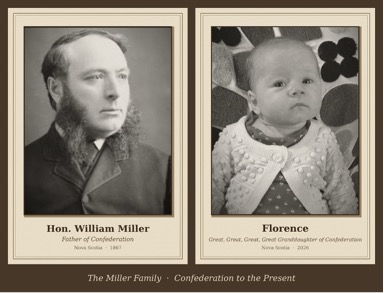
One more test belongs beside these five steps, and it is older than any of them. On April 3, 1866, a relative of mine, William Miller, rose in the Nova Scotia House of Assembly and made the proposal that opened the way for the province to join Confederation. My granddaughter Florence was born six generations later. The Haudenosaunee teaching of the seventh generation asks leaders to weigh a decision by its effect on people not yet born. In Mi’kma’ki, where I live, the principle of netukulimk holds the ancestors, the living and the generations to come within a single obligation. Did the legislators of 1866 think seven generations ahead? Do we? The rules we write for artificial intelligence will be judged by Florence and her generation. She looks like a pretty severe judge.
At this stage she is keeping her thoughts on a new economic model to herself. I would encourage her to start by reading the work of Daron Acemoglu and Joel Mokyr, Nobel laureates in economics in 2024 and 2025 respectively. Acemoglu, of the Massachusetts Institute of Technology, holds that the direction of a technology is chosen and not fated. He expects AI to add only modestly to output over the next decade, and argues that the gains will be widely shared only if we build tools that make workers’ skills more valuable instead of tools that simply replace them. Mokyr, an economic historian at Northwestern University, is the more optimistic of the two. He expects AI to make us more productive and does not think machines will replace us. What worries him is whether our institutions will keep pace, because technology that outruns them puts power in the hands most likely to misuse it. Their emphasis differs, but they agree on the point of this essay. The outcome will be decided by rules and institutions, and not by the technology.
Conclusion: What We Have Learned
The old joke assumes that the turkeys are the problem. They are not. They have read the menu correctly.
Forty-five years have taught three lessons. The first is that productivity pursued as an end in itself drains the trust on which productivity depends. The second is that revolt is not a remedy. Populism named the injury and left it untreated. The third is that the old order cannot be restored, because it is the order that produced the revolt.
What we lack is not technique. We have more technique than any society in history, and artificial intelligence is about to give us more. What we lack are ideas, a belief system and ideals equal to it. The neoliberal era had all three. Its idea was efficiency. Its belief was that the market is the best judge of value. Its ideal was the individual free to choose. They were coherent, which is why they prevailed for so long. They were also too small. They had room for one generation, the baby boom generation, and for one kind of life, the consumer’s. That has left much insecurity for the generations that follow.
What replaces them will have to be larger. It must have room for past generations, whose work, institutions and public investment built what we now count as capital. It must have room for the present generation, who are entitled to share in what they produce. It must have room for future generations, who will inherit either the assets or the bill. And it must recognize what Polanyi saw when he insisted that land is not a commodity, and what Drucker meant when he called himself an ecologist. The economy sits inside society, and society sits inside the living world. All forms of life are intertwined. In Nova Scotia the Mi’kmaq have a phrase for this that is far older than economics: Msit No’kmaq, all my relations.
Thanksgiving, properly understood, is that belief in the values of gratitude, community and generosity, in the form of a ritual. It gives thanks for the harvest and the sharing of the bounty. It shares the harvest among those who brought it in. It keeps seed for those who will come after. And it admits that the harvest was never ours alone to make. That is the holiday worth voting for.
The choice between the two holidays is a matter of design, and section 36 of the Constitution Act, 1982 shows the way. It commits governments to promoting equal opportunities for the well-being of Canadians. It points to how AI for All can lead to well-being for all, if we set the right goals and measure them. Canada will have the productivity it has pursued for forty-five years when the people who produce it have a seat at the table. My father hoped to return and tell how his company prospered. Ten years from now, when I am seventy-four, I would like to tell my granddaughters how Canada changed so they could have a good life. The story will only be true if the prosperity is shared.
Bernard F. Miller, KC, ICD.D, is a contributor to PolicyWonks.ca. He is Executive Chair of Restorative Change Lab CIC, a board member of the Windsor Foundation, Managing Trustee of the Killam Trusts, and a federally appointed member of the Canada-Nova Scotia Offshore Energy Regulator, which is funded jointly by the federal and provincial governments. He was formerly Nova Scotia’s Deputy Minister of Business and Deputy Minister of the Office of Strategy Management, and Managing Partner of McInnes Cooper. His father, Bernard F. Miller, was Vice President, Personnel, at Air Canada. The views expressed are his own and do not represent any organization with which he is or has been affiliated.
Sources
- Vanmala Subramaniam, “Canadian businesses are betting on AI to boost productivity. These chokepoints are getting in the way,” The Globe and Mail (November 20, 2026), theglobeandmail.com
- House of Commons (United Kingdom), debate on the motion of no confidence, Hansard (March 28, 1979); background at wikipedia.org
- Government of Canada, Canada’s National Artificial Intelligence Strategy: AI for All (June 2026), canada.ca
- Karl Polanyi, The Great Transformation (Rinehart, 1944)
- Ronald H. Coase, “The Nature of the Firm,” Economica (1937)
- Michael C. Jensen and William H. Meckling, “Theory of the Firm: Managerial Behavior, Agency Costs and Ownership Structure,” Journal of Financial Economics (1976)
- Adam Smith, An Inquiry into the Nature and Causes of the Wealth of Nations (1776), Book V
- Philip Selznick, Leadership in Administration (Harper & Row, 1957)
- Peter F. Drucker, “Reflections of a Social Ecologist,” Society (1992), doi.org
- Raghuram Rajan, The Third Pillar: How Markets and the State Leave the Community Behind (Penguin Press, 2019)
- Presidential job approval polling averages, November 12, 2026 (Silver Bulletin, Decision Desk HQ, RealClearPolitics), as compiled at wikipedia.org
- Stephen Fowler, “Elon Musk is leaving the federal government. What’s next for DOGE?”, NPR (May 30, 2025), npr.org
- TheWrap, “Jeff Bezos Defends Amazon’s ‘Melania’ Documentary: ‘A Good Business Decision’” (2026), thewrap.com
- NVIDIA Corporation, “NVIDIA Board Reinstates Jensen Huang as President, CEO and Board Director,” press release filed on Form 8-K (November 23, 2026), sec.gov
- CNBC, “Trump sealed deal for Nvidia to rehire Jensen Huang as CEO” (November 23, 2026), cnbc.com
- The Associated Press, United States House of Representatives election results, as of November 22, 2026
- Al Jazeera, “10 years after divisive Brexit referendum, UK weighs a ‘Breturn’ to the EU” (November 20, 2026), aljazeera.com
- Peter F. Drucker, Concept of the Corporation (John Day, 1946)
- Peter F. Drucker, “The Age of Social Transformation,” The Atlantic Monthly (November 1994)
- Daniel Immerwahr, “Polanyi in the United States: Peter Drucker, Karl Polanyi, and the Midcentury Critique of Economic Society,” Journal of the History of Ideas (July 2009), northwestern.edu
- Bernard F. Miller, “Productivity or Perish,” in Frances Bairstow, ed., The Productivity Crisis and Labour Relations (McGill University, Industrial Relations Centre, 1981)
- Milton Friedman, “The Social Responsibility of Business Is to Increase Its Profits,” The New York Times Magazine (September 13, 1970)
- Daron Acemoglu and Simon Johnson, Power and Progress: Our Thousand-Year Struggle Over Technology and Prosperity (PublicAffairs, 2023)
- MIT Department of Economics, “Daron Acemoglu: What do we know about the economics of AI?” (December 2024), mit.edu
- Daron Acemoglu, David Autor and Simon Johnson, “Building Pro-Worker Artificial Intelligence,” NBER Working Paper 34854 (February 2026), nber.org
- Marketplace, “Nobel laureate Joel Mokyr on innovation, AI, and humans messing things up” (October 15, 2025), marketplace.org
- Edmund Phelps, Mass Flourishing: How Grassroots Innovation Created Jobs, Challenge, and Change (Princeton University Press, 2013)
- René Morissette, Wages in Canada, 1981 to 2024, Statistics Canada (June 2025), statcan.gc.ca
- Tahsin Mehdi and Marc Frenette, “Hiring and job separation rates in the era of generative artificial intelligence: Early evidence,” Statistics Canada (October 28, 2026)
- World Happiness Report 2026
- Environics Institute for Survey Research, Confederation of Tomorrow survey tables, 2019 to 2024, environicsinstitute.org
- Elections Alberta, official referendum results (October 29, 2026), elections.ab.ca
- Nova Scotia House of Assembly, Debates and Proceedings, speech of Mr. Miller on the union of the colonies (April 3, 1866), uvic.ca
- Nova Scotia Department of Education and Early Childhood Development, Mi’kmaw Services Branch, “Netukulimk,” including Msit No’kmaq, novascotia.ca
- Nova Scotia Museum, Ta’n me’j Tel-keknuo’ltiek: How Unique We Still Are, novascotia.ca
- BCE Inc. v. 1976 Debentureholders, 2008 SCC 69; Canada Business Corporations Act, s. 122(1.1)
- Constitution Act, 1982, s. 36, laws-lois.justice.gc.ca
Further Reading
- Productivity and Perish, PolicyWonks.ca
- Milton Friedman Was Wrong, PolicyWonks.ca
- The World Out of Balance, PolicyWonks.ca
- What a Slow-Growth Law Firm Taught Me About Nova Scotia’s Economic Policy, PolicyWonks.ca

